Showing posts with label 1934 Manila Carnival. Show all posts

Wednesday, August 14, 2013

254. Carnival Beauties: LEONARDA OCAMPO, Miss Philippines 1934 Candidate

A PRETTY GIRL IS LIKE A MELODY. Leonarda Francisco was a music student of St. Scholastica when she made a bid for the Miss Philippines 1934 crown. This lovely Nueva Ecijana became a well-known concert pianist later in life.

 Leonarda Ocampo, was the first female graduate of Saint Scholastica College's Conservatory of Music. She was still a student when she was prevailed to run for the 1934 Manila Carnival search for Miss Philippines. She originally represented her province of Nueva Ecija having been born in Brgy. Bangad, Cabanatuan.The crown went to the Marilao beauty, Clarita Tan Kiang.

Leonarda became a well-known concert pianist. She passed on the musical genes to her descendants, which include the award-winning composer Louie Ocampo and Fr. Manoling Francisco S.J., composer of the well-known songs, "Hindi Kita Malilimutan" and "Tanging Yaman". A school that stands on a piece of land donated by the family in Cabanatuan City is named after this musical beauty.


Friday, February 22, 2013

239. Crowning Moment: CONSUELO VILLAMOR, Miss Mindanao 1934

SEE YOU IN COURT. The official coronation picture of Miss Mindanao 1934, Consuleo Villamor, with her own retinue of beauties in regal Muslim costumes. She is escorted by her brother, Domiciano.

The tradition of having separate coronation nights for the princesses of Miss Philippines began in 1929, with the election of Pacita de los Reyes of U.P. Not only was the new Miss Philippines given her own Coronation Night, but there were also separate affairs for Miss Luzon, Miss Visayas and Miss Mindanao, which were no less fabulous.

The picture above shows the crowning moment of Abra beauty, Consuelo Villamor (b.1911/ d. 2009), who was Miss Mindanao in the court of 1934 Miss Philippines, Clarita Tan Kiang. True to the title she won, her whole court came in signature Muslim costumes. One of her attendants was Evelina Kalaw, sister of Miss Philippines 1931, Maria Kalaw. Consuelo is shown here with her Prince Consort, Domiciano Villamor, her brother.

Wednesday, January 23, 2013

237. Carnival Wedding: MAURICIO-CUENCA NUPTIALS (1934 Miss Visayas)


Marcelina Cuenca was a former Miss Manila and The Philippine Free Press' representative to the  1934 search for Miss Philippines. She won Miss Visayas (3rd place) after Luisa Laconico (Miss Luzon) and Clarita Tan Kiang (1934 Miss Philippines). A year after the contest, she wed Dr. Conrado Mauricio on 16 June 1935. Shown along with the newlyweds in this picture are: L-R: Lourdes Mauricio (bridesmaid), Julita Cuaderno (maid of honor) and Dr. Leon Ma. Guerrero Jr. (Best Man).

Sunday, December 18, 2011

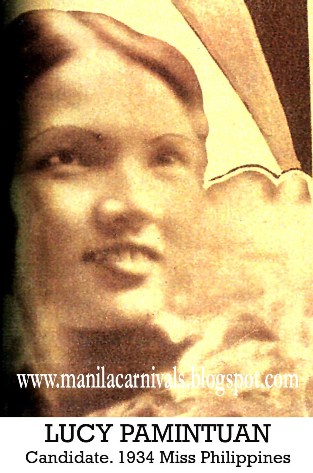
196. Carnival Beauties: LUZ CENTENO PAMINTUAN, Candidate, 1934 Miss Philippines

WIN OR LUZ. Lucy Pamintuan,a well-travelled society belle from Angeles, one of 3 Kapampangans who competed for the 1934 Miss Philippines crown.

The search for Miss Philippines in the 1934 Manila Carnival was touted as the tightest race ever by observers who took note of the high pedigree of the candidates who gamely joined the contest that year.

The A-list included UP students Consuelo Villamor (sponsored by The Tribune) and Clarita Tan Kiang (Philippine Collegian), Pacita Madrigal, daughter of Don Vicente Madrigal and Susana Paterno (Dee Tees), Miss Manila Marcelina Cuenca (Philippine Free Press), Vice President Sergio Osmeña’s daughter, Maria Osmeña (Bisaya), Zambangueña society girl Pilar Blanco, Angelina Diy (El Debate) and Pura Luna (Bulaklak).

Pampanga was represented by 3 beauties, who surprised beauty fans by becoming leading candidates throughout the voting period: Luz Pamintuan of Angeles, Luz Sarmiento of Bacolor and Remedios Ibarra of Guagua.

Luz “Lucy” Pamintuan,was born in 1915, the 5th child in a brood of 11, of Don Florentino Torres Pamintuan of Angeles with 2nd wife Tomasa Centeno of Pulung Bulu, a daughter of his tenant-farmer. Don Florentino was a Georgetown University-educated lawyer, who counted Sergio Osmeña, Manuel L. Quezon, Isauro Gabaldon, Manuel Roxas and Claro M. Recto as friends. After the death of her father in 1925, her mother Masing, went on to manage her husband’s sugar planting business successfully, becoming a founder and stockholder of Central Luzon Milling Company and a member of Pampanga Sugar Development Corp. (PASUDECO).

Lucy attended Holy Ghost College and Assumption Academy. When her father went to the U.S. for his advanced law studies, Lucy tagged along and went to Immaculate Seminary in Washington. A well-travelled girl, she has also visited several countries in Europe. Lucy also became a popular member of the elite Smiles Club, Rho Alpha and the local Catholic Women’s League. In 1934, sponsored by the newspaper Excelsior, Lucy joined the Miss Philippines search in the annual Manila Carnival. U.P. law student Clarita Tan Kiang, however, won the final counting on 30 January 1934.

Not one to dwell on this setback, Lucy thereafter became the toast of Pampanga’s high society, meriting a special section in the 1936 Pampanga Social Register, a book that featured the movers and shakers of Kapampangan society. She married twice--first to Fernando Casanovas, then to Jorge Halpern Garcia. She, however, remained childless. Lucy Pamintuan passed away on 1 December 1965 at a relatively young age of 50.

Tuesday, September 27, 2011

191. Carnival Beauties, PILAR BLANCO, Candidate, 1934 Miss Philippines

PILLAR OF BEAUTY. Pilar Blanco, a classical pianist from Cebu, was a popular candidate to the 1934 Manila Carnival quest for Miss Philippines. Her daughter is also a concert pianist of repute, Ingrid Sala-Santamaria. Ca. 1934.

Pilar Blanco was a budding classical pianist from Cebu when she started attracting the attention of local beauty aficionados. She was one of the first graduates of Sister Baptista Battig, a German Benedictine nun who came to Manila in 1908 to teach music. The good sister rented out pianos in makeshift classrooms and taught Filipino students Western music and techniques.

Among Pilar’s co-students were Marcela Agoncillo, Pacita Zaragoza, Blanca Castillo and Imelda Katigbak; the latter two became concert artists. Pilar herself was an ardent and accomplished pupil of Sr. Battig. Eventually, Sr. Battig would eventually set up a regular music department in a Singalong school that would be known as St. Scholastica’s College.

When it was time to nominate a candidate for the queenship of the 1934 Manila Carnival, Pilar’s name was submitted by the newspaper, “The Social Fountain”, which avidly supported her. Hopes were high for the Cebuana who not only possessed mestiza good looks but also an exceptional musical gift. But competition was stiff that year; the crown went to a Chinese-Filipina from Marilao, Clarita Tan Kiang, a student of the University of the Philippines.

Pilar, however, had other things planned, one of which was to marry her handsome beau, Salvador E. Sala, an educator. Even with a family to care for, Pilar continued her passion for the piano, by setting up a music school in her native Cebu. She named it the Battig Piano School, in honor of her mentor, and when her daughter Ingrid came of age, she became her first tutor. Ingrid Sala-Santamaria would pursue her advanced music studies at the world-famous Juilliard School and become a concert pianist of note.

The flowering of the golden age of music in Cebu is credited to the relentless promotion of Pilar Blanco-Sala and her family. It was she who established the Cebu Youth Symphony Orchestra (CYSO), later to be known as the Peace Philharmonic of the Philippines. The Sala children honored their parents with the creation of Salvador and Pilar Sala Foundation, Inc. (SPSFI) in Cebu on 10 October 1998, a non-governmental organization that implements social projects in the field of education and music.

Wednesday, September 14, 2011

188. Carnival Beauties: MARIA PALOMA OSMEÑA, Candidate, 1934 Miss Philippines

PRESIDENTIAL DAUGHTER , Maria Paloma Osmena, Candidate, 1934 Miss Philippines.

In 1934, the participation of one candidate to the annual Miss Philippines search of the Manila Carnival elicited a lot of interest and media following. Maria Paloma Osmeña after all, was the daughter of Sergio Suico Osmeña (1878-1961), governor of Cebu and Speaker-elect of the 1907 Philippine National Assembly. He would go on to become a Vice President of Manuel L. Quezon in 1935, and eventually become the 4th president of the Philippines (1944-46) after Quezon’s death.

Maria’s mother, Estefania Chiong Veloso, had 9 other children with Sergio: Nicasio, Vicente, Edilberto, Milagros, Emilio, Jesus, Teodoro, Jose, Sergio Jr. Maria’s brothers were involved at some point in Carnival activities like Nicasio or Nick and Emilio, who provided escorting duties to some of the Carnival royalties. Maria’s father would marry a second time to Esperanza Limjap, herself a former Manila Carnival princess.

Maria’s candidacy was supported by a leading newspaper. The competition that year was stiff, with the UP collegian candidate, Clarita Tan Kiang prevailing over the rest of the candidates that also included Lucy Pamintuan, Luz Sarmiento, Pilar Blanco, Pura Luna, Consuelo Villamor and Angelina Diy. Still, her Carnival experience was something she would not forget.

Ten years after, she met and married an accomplished classical pianist in New York on October 1944, James Milne Charnley. Charnley often accompanied opera singers like Bidu Sayao, a Metropolitan Opera House soprano and one of Brazil’s most famous artists. They settled in New York, New York.

When Pres. Diosdado Macapagal changed the date of Philippine Independence to June 12, children of past presidents—including Maria Osmeña-Charnley, were present at the historic signing of the act on 4 August 1964. With her were Gerry Roxas, Carmen Melencio-Aguinaldo, Manuel Quezon Jr. and Tomas Quirino.

Maria and James regularly shuttled back and forth from the U.S. to the Philippines. James also got to accompany local Philippine divas like Nelia Manalo Concordia whenever they gave recitals. After her husband’s death, Maria settled back home in the Philippines and lived to be in her 90s. She reposes at the family mausoleum in Cebu.

Monday, September 5, 2011

185. Carnival Beauties: PACITA PATERNO MADRIGAL, Candidate, 1934 MIss Philippines

PAGEANTRY, POLITICS AND PACITA. The 15 year old Pacita as a high schooler of Philippine Women's College (now University). She went on to become a Senator in 1955, only the 2nd woman to achieve that feat--and an election topnotcher at that! Ca. 1930.

In the 1934 quest for Miss Philippines, one lovely candidate turned heads not only for her illustrious pedigree and family wealth but also for her academic brilliance that would served her well in the future. Pacita Madrigal y Paterno would go on to greater heights by entering politics and topping the senatorial elections of 1955 under the Magsaysay Administration.

Maria Paz or Pacita was one of the 7 children of the influential senator and millionaire, Don Vicente Madrigal y Lopez of Albay with Susana Paterno y Ramos of Laguna. Born in 1915 in the San Miguel district of Manila, she grew up together with her siblings Macaria, Josefina, Antonio, Jose, Consuelo Alejandra, and Maria Luisa.

Pacita studied at the Philippine Women’s College. At age 15, she became a leading candidate for the title of "Princess of Education", a contest conducted on the occasion of the San Juan de Letran's Tercentenary activities, her father's alma mater. She graduated as high school valedictorian in three years; was medalist at the Sorbonne University, Paris and graduated magna cum laude in business administration at the University of Santo Tomas. She also went to 2 finishing schools: the Collège Féminin de Bouffemont at Seine, Paris, and at the Powers School in New York.

At age 19, Pacita was sponsored by Dee Tees, a leading publication of the Commonwealth years, to be their candidate to the annual Miss Philippines Beauty Contest of that year’s Manila Carnival. Competition was stiff—there was the Spanish mestiza Pilar Blanco, Maria Osmena, Marcelina Cuenca (former Miss Manila) and the 2 Kapampangan belles, Lucy Pamintuan and Luz Sarmiento to contend with. And there was the Chinese mestiza beauty from UP, Clarita Tan Kiang, who eventually won the crown.

But Pacita had other things in mind than being just an icon of beauty. She was soon abroad to further enrich her education. She was in New York when World War II broke out on 8 December 1941. Determined to maker herself useful, Pacita took up Red Cross work and also volunteered at the Walter Reed Hospital.

After the war, she married Herman Warns, a Manila Gas Corporation executive and proceeded to establish her ballet school. But in 1953, she gave up her school to head the Women for Magsaysay Movement, and her interest in politics began. With Magsaysay’s victory, she assumed the position as Social Welfare Administrator.

Two years later, she decided to run for the Philippine Senate. Pacita, at age 40, became the first woman to ever top the senatorial elections. According to Time Magazine, she did so with the most number of votes ever garnered by a senatorial candidate up to that time (2,544,716 in all). She was just the second woman after Geronima Pecson, to be elected to the Senate.

As cabinet member when she was SWA administrator, she was involved in some 40 committees, councils, commissions, boards and institutes—from the Council of State, Community Development Council, Slum Clearance Committee, Community Chest to the Philippine National Red Cross, Pan Pacific Women’s Association, and Philippine Committee of United Nations Appeal for Children.

After the death of Herman Warns, the widowed Pacita married lawyer Gonzalo Gonzales in 1956. She was defeated for re-election in 1961 after accusations arose about her misappropriation of public funds in 1956. Had her credibility not been damaged by the charges, she could have posed as a serious threat to Carlos P. Garcia’s presidential candidacy in 1961. The Manila Carnival beauty who could have been the world’s first female head of state, died at the age of 93 on 12 September 2008.

Sunday, August 21, 2011

183. Carnival Beauties, DAISY P. HONTIVEROS, Miss Mindanao, 1934 Cebu Carnival

PICKING DAISY. Kahirup's bet to the Cebu Carnival Queen search--Daisy Hontiveros--would become a leading force in advancing the cause of Philippine theater, in partnerhsip with her husband, award-winning director and National Artist, Lamberto Avellana Sr. She is shown here at age 17.

In the court of the 1934 Cebu Carnival Queen Maria Lagrimas Ong, one lovely runner-up was destined for even greater things after her fourth place finish in the quest for the province’s carnival royalty. Daisy Pardo Hontiveros, who reigned as Miss Mindanao (Julieta Abad was Miss Visayas and Julia MacVean was Miss Luzon), would become the future wife of National Artist and award-winning film director Lamberto Avellana and would distinguish herself as a leading light in Philippine theater.

Lourdes Genoveva Dolores Pardo Hontiveros was born on 26 January 1917 in Capiz, Capiz to Jose M. Hontiveros and Vicenta R. Pardo. She was the eldest in a brood of 10 children, that included Jose, Leon Jose, Alejandro, Renato Jose, Eduardo Jose, Juan Nepomuceno Jose, Ma. Teresita Vicenta, Benjamin Jose and Ramon Nonato.

Nicknamed “Daisy”, she went to the Assumption Convent in Iloilo for her elementary years beginning in 1924. In 1930, she started high school at Capiz High. It was here that she was chosen as Miss Capiz and, in her senior year, she was prevailed upon by the influential Kahirup Club to join the quest for the 1934 Queen of the Cebu Carnival. Young Daisy did not disappoint her sponsors and emerged as Miss Mindanao.

That same year, after graduation, Daisy was accepted at the University of the Philippines in Padre Faura where she took a drama course. She became a very popular and accomplished actress in school, and was named 1st Intercollegiate Girl in only her first year. She also became a talented writer (editor of Philippine Herald in 1937-38) and radio actress.

On 19 June 1938, she married Lamberto V. Avellana at the Remedios Church in Malate, whom she had previously met in 1932 at a party. The two had actively immersed themselves in theater and radio work and this interest led them to organize the Barangay Theater Guild in 1939. They had four children: Marijo (died in infancy), Mari, Ivi and Bating.

Lamberto Sr. would earn fame with his film “Anak Dalita” which won the Grand Prix at the Asian Film Festival in Hong Kong in 1956. Their theater guild produced the Nick Joaquin play, “Portrait of the Filipino as an Artist”, which became the longest-running play in the Philippines. Daisy appeared as Candida in the 1965 film version.

When Lamberto passed away in 1991, Daisy carried on with her theatrical pursuits, and in 1994, she was named “The Cinema’s Living Treasure” at the Manila Metro Film Festival. She was also a Centennial Awardee for Theater by CCP. Aliw Awards honored her with a Gawad Siglo ng Aliw for Theater in 1999. Daisy continued directing stage readings of plays at FEU from 2002-2006. On her 90th birthday, she was given a tribute by the CCP and NCCA. The province of her youth, Capiz, honored her, along with Jovita Fuentes, with a “Saludo” in 2009.

Sunday, July 17, 2011

178. A Program Description: The 1934 MANILA CARNIVAL

(Taken from the Manila Carnival Commercial and Industrial Fair Program, 27 January-11 February 1934)

All is set for the 1934 Carnival. With things beginning to look rosy in the business horizon, we look forward to a successful reign of Billiken in the Carnival City, both in point of attendance and in the variety of attractions in the big show. Well may we have such an elaborate arnival to welcome the approach of a better era in business which, in the words of some business prophets, “is just around the corner”.

This year’s Carnival will again run for sixteen days and nights in the beautiful cit of lights on Wallace Field, Manila. Starting on January 27, next, it will not end until the wee hours of February 12. It is the purpose to make of this festival a truly never-to-be-forgotten period of revelry mirths and laughters; of funs, frolic, dancing and all other sorts of amusements; of riotous colors and exquisite and fantastic shows and sights; of impressive and colorful pageants and parades’ in short, of all those things that are devoted to the sunny side of life.

Famous show places the world over have been ransacked for novelties for the coming Carnival. From all indications, the public will be treated to a series of new features in the line of shows that will long be remembered by Carnival visitors for their variety and gorgeousness. The management is bent on realizing, to the fullest extent, the principal aim of the association, which is to provide once a year a period of wholesome enjoyments which, people tired of the year’s daily grind, sorely need for their physical and mental uplift.


Now will these be all for the thousands of Carnival enthusiasts. Recreation places, eating parlors, hot dog stands, and beer and soft drinks gardens will be found in the different sections of the Carnival City ready to serve the public. The famous Carnival Auditorium where Miss Philippines hold court every night as Carnival Queen, also affords to the sensation seekers attractive and tantalizing spectacles noted for their gayety and glamour.

On the other hand, those inclined to be serious can find plenty of food for thought in the Army and Navy exhibits, in the display of arts and sciences of some bureaus or educational institutions, and in the Commercial and Industrial Fair section where made-in-the-Philippines products galore greet the eyes of the public. Here, the different provinces of the Philippine Archipelago vie with each other in presenting in a most effective manner their various industries and economic resources; while different government bureaus and offices also try to acquaint the public, through exposition and practical demonstration, with their varied activities intended to promote the well-being of the nation.

There will also be found there a horticultural show that is decidedly among the most interesting and highly instructive exhibitions in the entire Carnival, and the well decorated booths of local and foreign manufacturers where their respective wares are exhibited and sold to the milling throng that usually jam the industrial and commercial fair.

Wednesday, May 20, 2009

73. 1934, MISS LUZON, MISS VISAYAS, MISS MINDANAO


LUISA LACONICO, Miss Luzon 1934


Luisa sought to extend the reign of beauty of the Laconicos by running for the Miss Philippines queenship in 1934. It was a tall order, as the reigning royal was her own first cousin, so it was unlikely that she would figure at all in the finals. Her facial beauty and form were outstanding, even by today’s standards (she was called ‘Body Beautiful'). It came as no surprise that she placed a strong second in the finals, claiming the 1934 Miss Luzon title.

At the coronation, she was escorted by Hector Gomez, whom she eventually married the next year at the Quiapo Church. Their main wedding sponsors were Dna. Angela de Butte and Gov. Ramon Racelis.

******


MARCELINA CUENCA, Miss Visayas 1934


Marcelina Cuenca, the 1934 Miss Visayas had represented Manila in the Philippine Free Press search for Miss Philippines. In the finals, she placed second to win the Miss Luzon title. She took one more shot at the more prestigious quest for Miss Philippines of the Manila Carnival and earned a spot in the winner’s circle by becoming Miss Visayas. Her Prince Consort was Antonio Albert.

******


CONSUELO VILLAMOR, Miss Mindanao 1934

Consuelo, Miss Mindanao 1934, was the daughter of Pedro and Josefa M. Villamor. She was born on 26 September 1911 in Bangued, Abra. Her siblings included Domiciano, Baldomero, Belen (Sr. Thecla of St. Paul) and Luz. “Consoling” spent her early years in Abra, but at various times, she also lived in Sta. Rosa, Laguna and Cabanatuan for her high school education. She was a popular girl in her time, famous for her beauty and intellect, and for which she was elected Miss Abra.

When she went to Manila to study at the University of the Philippines, her popularity grew even more. She became a cadet sponsor of the school’s R.O.T.C., an honor reserved for accomplished campus beauties. When nominations for the 1934 Miss Philippines opened, Consuelo was the overwhelming choice of U.P. She did not disappoint, as when the judges handed out their decision, they included the lovely Consoling in the winners’ list as Miss Mindanao.

The heady Carnival days soon ended and Consuelo went back to her books at the state university. Upon graduation, she taught at her alma mater and became an accomplished academician, educator and author, serving U.P. for many years. The grateful school named her a Professor Emeritus.

In the midst of her career, she married Abraham A. Asis and bore three children, Antolin, Victor and Angela. The Villamor family settled in San Juan. Consoling lived a long and full life, outliving all her siblings, husband and two sons. She passed away on 6 April 2009, just a few months short of her 89th birthday.

72. 1934, Miss Philippines of the Manila Carnival, CLARITA VILLARICA TAN KIANG

1934 MISS PHILIPPINES. Winsome Chinese-Filipina beauty Clarita Tan Kiang emerged victorious as the queen of the national fair. Her father was pure Chinese from Amoy.

In the 1934 edition of the Manila Carnival, the Miss Philippines crown went to an Oriental Filipina beauty, instead of the Spanish mestizas who had regularly dominated the past editions of the pageants. That year's winner was UP coed Clarita Tan Kiang. Clarita's father, Eduardo Tan Kiang, was born in Amoy, China and arrived in the Philippines as a young boy. He met and married Luisa Villarica and the couple settled in Marilao, Bulacan. Eduardo would serve as the first municipal mayor of this town and would further expand his family to 10 children.


When the children came of age, they were sent to Manila schools, and so the Tan Kiangs eventually spent more time in the city than in Marilao. Besides, Eduardo had other business interests in Manila. Clarita, the second eldest child, finished high school at the Holy Ghost College. Simultaneously, she also took up music courses at the University of the Philippines Conservatory of Music.


It was as a high school student that she was nominated to vie for the Miss Philippines title, and The Philippine Collegian became her major sponsor. Clarita had, as her main drumbeater, Arturo Tolentino, the editor of the school publication.Clarita was wrote about in the school paper in glowing terms—from her “laughing eyes, bedimple smile” to her voice that was likened to “the tinkle of golden bells”.


However, Clarita faced formidable opponents at the pageant. She had to contend with the reigning Miss Manila, Marcelina Cuenca and a bevy of Kapampangan belles led by Luz Sarmiento of Bacolor and Lucy Pamintuan of Angeles, daughter of Pampanga’s very affluent hacendero, Don Florentino Torres Pamintuan. Then there’s Luisa Laconico, a cousin of last year’s winner, Engracia, who was no less beautiful.


The Chinese community’s support of Clarita proved pivotal, as when all the votes were accounted for, Clarita came on top of the heap. She was thus proclaimed as Miss Philippines of the Eight National Beauty Contest in glittering ceremonies at the Carnival Auditorium together with her court: Luisa Laconico as Miss Luzon, Marcelina Cuenca as Miss Visayas and Consuelo Villamor, a UP schoolmate, as Miss Mindanao.


She received her crown that was uniquely designed with three stars representing the island groups—one star as a center topper, and two, dangling on strings of pearls. Clarita kept this crown as a memento of her reign all her life. She wore a sequined terno at her coronation, but changed to a billowy long sleeved gown with a long train for her Miss Philippines Night. Her damas wore identical ruffled numbers, with consorts dressed as Grecian princes.


It was back to her studies at U.P. when the Carnival ended, and she made up for her lost time by taking summer classes. She finished high school in 1935 and continued with her music course at the U.P. Later she enrolled at the College of Banking, Business and Economics, but her studies were interrupted by the coming War. Clarita did not remain idle and instead, she worked with a group that ministered to ailing former prisoners in a Pasay-based hospice. She worked tirelessly to maintain this home for convalescing war patients.


When the war years ended, she went back to her books, enrolling at the Philippine Law School, and earned another beauty title—Miss Justice—as part of the school’s silver anniversary celebration. It seemed that Clarita was too busy to make time for romance; she was already in her 40s when she found true love.


In one Malacanang occasion, she was introduced to Conrado Sanchez, a widower and a former law school professor, by First Lady Trinidad Roxas, herself a former Carnival Queen. Conrado was all set to become a Supreme Court Justice when he was smitten by Clarita. They tied the knot on 9 May 1965 and adopted a child in 1969.


After law school, Clarita immersed herself in the Tan Kiang family business and founded professional women’s organizations such as the Women’s Management Association and the Women’s Lawyers’ Association. She remained involved in socio-civic causes in her golden years, but she also continued to honor her roots by keeping her Marilao haven until her death.