Showing posts with label Philippines. Show all posts

Wednesday, March 13, 2024

277. 1909 Queen of the Occident: HELEN MINOR DORRINGTON


1909 QUEEN OF THE OCCIDENT, HELEN DORRINGTON 

The quest for dual queens to rule over the festivities of the national fair was continued when the 2nd edition of the Manila Carnival went underway in 1909. There was no problem with the search for the Oriental Queen as there were so many qualified beauties to choose from--the Ilocana Julia Agcaoili was elected to reign as the native sovereign. Finding the Occidental Queen to succeed Marjorie Colton was more challenging as there were few American misses around at that time.


To make the lives of the carnival organizers easier, one of the ladies in Miss Colton’s 1908s court was quickly handpicked to take over her throne—Nebraska-born Helen Minor Dorrington (b. 5 Aug. 1888/ d. 5 Mar. 1984). The 21-year old beauty came from a family of impeccable pedigree, the daughter of Col. Lafayette Albert Dorrington (b. Feb. 1864/ d. 8 Oct.1934), a Spanish-American War veteran.


He had served as the government receiver of land in Chadron, back  in 1888, when the government opened up the Sioux Indian lands for homesteading. Entering the Spanish-American War, he served as a first lieutenant in the 34th infantry and later in the Philippine-American War, where he commanded a group of 50 male scouts.


After the war, and upon the establishment of the civil government in 1900, Dorrington was made the custodian of all government buildings in Manila. He also was member of the Masonic and Elks lodges in Manila.


Helen’s mother was Cordelia Augusta Minor, a Missouri native (b.12 Jul. 1863/d. 12 Jan. 1957), a direct descendant of Mary Ball, the mother of George Washington, and a member of the Daughters of the American Revolution. She and her husband lived in Manila with their daughter, Helen, for many years, and became a prominent part of the growing American community that regularly took part in social activities and goodwill-building events that included the Manila Carnival.


QUEEN OF THE ORIENT, JULIA AGCAOILI

From a member of the 1908 Occidental court, Helen became the Queen of the Occident, reigning alongside the native Queen of the Orient. Not much is known about her reign; one extant picture of her appears on a 1909 Carnival supplement published by Philippine Free Press. It shows a crowned, aristocratic-looking woman with an austere smile, dressed in a glittering gown, and bedecked with jewellery like necklaces and rings.


Four years after her 15 minutes of fame, Helen Dorrington returned to the United States in 1913, following the appointment of her father as chief inspector of the interior department in Washington. It was here that Helen met and married Air Force Col. Henry Clinton Kress Muhlenberg of Missouri (b. 6 Nov 1886/ 20 Dec. 1967). 

HELEN'S HUSBAND, COL. HENRY KRESS MUHLENBERG

The Dorringtons stayed in Washington for twelve years until moving to Sacramento, California in 1925 to establish the Indian Agency. Helen and Henry Kress Muhlenberg would have 2 sons, David, (b.6 May 1914/d. 28 Dec. 2010 ) and John (b.1916), and by 1944 were settled in Vista, San Diego County, along with her mother, Cordelia. David would become an air force colonel like his father, while John made Massachusetts his residence after marriage.


HELEN DORRINGTON'S GRAVE AT ARLINGTON

The elder Dorringtons would make a final move to San Bernardino County, where Helen was widowed in 1967. She would live for 17 more years, before passing away at age 95 in 1984. Like her military parents and husband, they are all buried at the Arlington National Cemetery, in Arlington County, Virginia.


SOURCES:

Philippine Free Press, 1909 Carnival Supplement

Photos: Findagrave, Col. La Fayette A. Dorrington, Cordelia Augusta Minor Dorrington, Helen Dorrington, Col Henry Clinton Kress Muhlenberg

“Indian Affairs Director'sWidow Dies At Age 93”, obituary news of Cordelia Dorrington, The Sacramento Bee, Sacramento, California, 17 Jan. 1957, p. 52.

Sunday, February 2, 2014

274. Carnival Memento: 1933 MANILA CARNIVAL POSTER

 CARNIVAL TIME! Cast your work aside and get ready for the masked revelry at the Manila Carnival of 1933!!

A colorful 1933 Manila Carnival poster, printed on the front cover of The Sunday Tribune Magazine, possibly drawn by renown artist, Fernando Amorsolo. The Manila Carnival Commercial and Industrial Fair was held from 4-19 February 1933, climaxed by the coronation of the 1933 Miss Philippines, Engracia Laconico.

Wednesday, January 22, 2014

273. Queen of the 1929 Negros Oriental Carnival: VICTORINA ANTONIO

 V FOR VICTORY. Queen Victorina I, the fair queen of Negros, as she looked at her coronation night.

In 1929, Negros Oriental held a provincial fair to celebrate their foundation day and to mark their prosperity and progress, primarily driven by their sugar industry. Chosen to reign as was the lovely Victorina Antonio. As Queen of the Negros Oriental Carnival Fiesta, she ruled over 70,000 people for two week of festivities.


Saturday, January 4, 2014

271. Carnival Beauties: CARMEN REESE, 1923 Baguio Carnival Princess

REESE AND FAMOUS. Mestiza-beauty, Carmen Reese of Baguio was part of the royal retnue of the Baguio Carnival of 1923.

Carmen Reese was a princess in the court of Queen Martina Salming, the reigning royal of the 1923 Baguio Carnival. Six years later, with her beauty in full bloom, Carmen was named as among Baguio’s candidates to the annual “Filipina Beautiful” of the Philippine Free Press. Other entrants were Adela Romero, Corazon Custodio and Rosita Moldero. Moldero, a Kalinga beauty from Labuangan, eventully clinched the 1929 Miss Luzon title of the prestigious newspaper contest.

Thursday, December 19, 2013

270. 1929 SAN PABLO PROVINCIAL FAIR

SCENES FROM SAN PABLO FAIR OF 1929

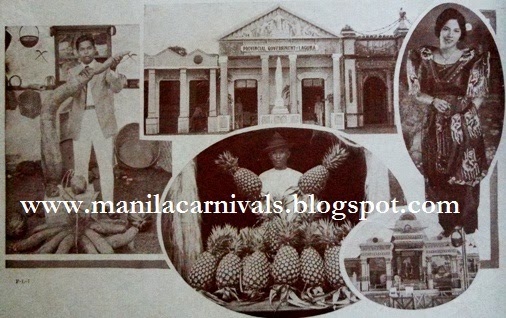
Proofs of provincial progress are depicted in these pictures from the community of San Pablo in Laguna, which celebrated its own fair in 1929. Here, one can see a representative San Pablo beauty. Extraordinary San Pablo pineapples and arrow root, and two specimens of San Pablo architectural skills: pavilions in the last fair held in that city.

Wednesday, December 11, 2013

269. 1934 BACLAYON (BOHOL) PETIT FAIR

BOHOLANA'S BEST. The Queen of the 1934 Baclayon Petit Fair and her royal court.

Queen Cresencia I (Cresencia Ginete) reigned as Queen of the Baclayon (Bohol) Fair with her court: Hospicia Valeroso, Agripina Oppus, Cresencia Real, Catalina Pates and Cornelia Talip. Previous to this, the only known Miss Bohol ever to participate in the Manila Carnivals was Ascension Gaviola, Miss Bohol 1926, who joined the 1st Miss Philippines search that year.

Thursday, November 28, 2013

267. Carnival Activities: 1933 MISS PHILIPPINES WITH MRS. MARGUERITE TEAHAN

TEA WITH MRS. TEAHAN.Miss Philippines 1933 Engracia Laconico as an official guest of Malacanang resident, Marguerite Teaha, sister of the incumbent Governor General and considered First Lady of the land.

Engracia Laconico, 1933 Miss Philippines, is shown with Mrs. Marguerite M. Teahan, sister of Philippine Gov. General Frank Murphy. Murphy took many of his relatives to the Philippines when he came over to serve as Governor-General (and later, High Commissioner) from 1933-1936. These include his brother, George, sister-in-law Irene Ellis Murphy, and Marguerite, who helped him in the many ceremonial functions of his office.

Marguerite was married to William Teahan (m. 2 June 1931), who became and advisor to Frank, The couple had an adopted daughter, Mary Aurora, named after Pres. Manuel L. Quezon's wife, Aurora Aragon.


Tuesday, November 19, 2013

266. Carnival Ads: 1934 MISS PHILIPPINES AS CELEBRITY ENDORSER

A MODEL OF GOOD FASHION SENSE. 1934 Miss Philippines, Clarita Tan Kiang of Marilao, Bulacan, endorses Genuine Indian Head Cloth in this Graphic Magazine print ad.

In later Carnival years (1933-39), the fair was kept alive with funding from various corporate sponsors that included big departments stores, cosmetic companies, among others. As such, part of the duties that the Manila Carnival winners performed was to appear on print ads as endorsers of the products of said sponsors.

1934 Miss Philippines, Clarita Tan Kiang appeared on one such ad for Genuine Indian Head Fabrics, a staple cotton introduced by Americans that was part of everyday life of Filipinos for over a century. Indian Head was first introduced in 1831 as high-quality, sturdy, rough-texture muslin brown cloth. Its sturdiness and quality became world famous and was even used as a medium of exchange for bartering in the Philippines.

In this print ad published on Graphic Magazine, Miss Tan Kiang gives her personal testimony of the merits  of this linen-textured cloth, affixing her signature--not unlike print ads of today endorsed by contemporary personalities, proof that even today, the pulling power of celebrities works on Filipino consumers.

Tuesday, October 22, 2013

263. THE 1924 CAPIZ PETIT CARNIVAL

CARMEN OF CAPIZ. The Queen of the 1924  Capiz Petit Carnival and her royal retinue, pose during the coronation night that duplicated the festive air of the national carnival in Manila.

Not to be outdone, the province of Capiz held its own carnival with opulence and gaiety that rivalled that of the capital city. It was a fortuitous event as their native son, Representative Manuel A. Roxas had, by 1921, married Trinidad de Leon, herself, a former Manila Carnival Queen. Roxas's political stature would soon rise, becoming a Speaker of the House for 12 consecutive years, and eventually elected as the country's fifth President.

The 1924 Capiz Petit Carnival had a certain Carmen I as Queen. There was to be another Capiz Carnival the next year, held on December of 1925. The next year, Capiz sent its first representative to the 1st National Beauty Contest of the Manila Carnival, in the person of Rosario Picazo.

Wednesday, October 16, 2013

262. Carnival Memento: SOUVENIR SILHOUETTE

THE GREAT PROFILE.  A Manila Carnival silhouette portrait from 1936, a favorite souvenir from the national fair.

French Etienne de Silhouette, a chronic shadow cutter, gave his name to this simple art of portraiture, using a person's shadow as a template. It was a cheap way to capture one's likeness, making use of featureless profiles either traced from a shadow and then filled in with black ink or cut freestyle using black paper and a pair of scissors.

The Americans introduced this art form in the 20th century, but it did not catch on, only a few Filipinos mastered this craft (a certain artist named Marcelino practiced this art).

A few surviving examples come from the Manila Carnival area, which had booths that offered silhouette portraits as carnival souvenirs. This particular example is courtesy of the 1936 Manila Carnival. 

The profile of a man in a tuxedo is cut from textured black paper and mounted on a special hardboard that had the text, "Souvenir from the Manila & Carnival Exposition 1936". 

Silhouette souvenirs were also given away at the 1953 Philippine International Fair.

Tuesday, October 8, 2013

261. Carnival Album: MISS MINDANAO 1936 & MISS MACABEBE

MACABEBELLES TWO. Miss Mindanao of 1936, Cleofe Balingit lends her royal presence to the Garden Day festivities in her town.

Reigning Miss Mindanao 1936, Cleofe Jayme Balingit, and her town mate, Miss Macabebe 1936, presided over the festivities of the Macabebe Garden Day, held on 29 February 1936.

Balingit, backed by her newspaper sponsor, "Ing Catimawan", barged into the winning circle by placing 4th to Miss Philippines 1936, Mercedes Montilla. She was a popular beauty official of her town, welcoming VIPs to participating in local events like this one.

After her reign, she made a name for herself as a Red Cross volunteer, and undertook many socio-civic causes.


Tuesday, September 3, 2013

256. Queen of the 1938 Tuguegarao Carnival: HERMINIA AQUINO

CAGAYAN LOVELY. Crowned queen, Herminia I, 1938 Carnival Queen of the Tuguegarao Fair.

Cagayanons have been holding provincial carnivals in their province since 1926, and the events have been held usually in Aparri. Not to be outdone, the capital town of Tuguegarao started to mount its own petit fair, in the 1930s.

The royal elect in 1938, Her Majesty, Queen Herminia I (Herminia Aquino) reigned at the Tuguegarao Petit Carnival held from Aug. 10-20.

Her princesses included Rosalinda Olivas and Rosario Escalambre. The King Consort is Henry Kanaga, and engineer in the local office of the Bureau of Public Works.

Tuesday, July 23, 2013

252. A Carnival Yearbook: CHARITY CROW YGOA, UST Class of 1939

CHARITY CROW YGOA, Class of 1939, Bachelor of Science in Commerce, College of Commerce and Business Administration, University of Santo Tomas.

For many beauties, life after the Manila Carnival went on as usual. 1933's Miss Luzon, Charity de Ocampo Crow not only settled down in domestic bliss with La Sallite Rafael Ygoa in 1938, but also went back to school to finish her college education at the University of Santo Tomas. While there, she was voted as the "Most Beautiful College Girl", tantamount to being named "Miss UST".


As one can see from her yearbook information, she led quite an active student life. She was the Vice-President of the Freshmen's Class from 1935-36 and was a Representative to the Central Student Board from 1938-39. The listing also includes membership in the Commerce Club and the Faculty Club for 4 years. In 1939, already married, Charity successfully completed her Bachelor of Science in Commerce degree with Honors.


The family relocated to Colombia and then returned to the Philippines, only to relocate to Spain due to the exigencies of Mr. Ygoa's work. After retirement, the Ygoas moved to the United States. Charity lived long enough to celebrate her Golden Wedding Anniversary; the lovely Fil-Ilongga beauty passed away in 1988.

Wednesday, July 3, 2013

251. Carnival Beauties: ANGELINA VILLAFRANCA, 1929 Miss Philippines Candidate

ANGELIC ANGELINA. 1929 Miss Philippines Candidate.

When the 1929 Manila Carnival re-opened after a year in hiatus, the search for Miss Philippines was expanded to include colleges and universities, making the quest even more competitive. There were candidates from well-known schools like the University of the Philippines, Centro Escolar de Senoritas, Sta. Rosa College--and even Manila College of Pharmacy.

From a lesser-known school came Angelina Villafranca, Miss Filipino Academy. She was no match, however, for the state university's candidate, Pacita de los Reyes, who had the whole school's campaign machinery behind her.

Thursday, June 27, 2013

250. Queen of the 1929 Tayabas Carnival: CONSUELO E. LIM

CHOLENG'S CHARM. Consuelo Lim poses for her official photo as candidate of the 1929 Tayabas Carnival.

 Inspired by the victory of their local girl, Luisa Fernandez at the 1927 Manila Carnival (she represented Manila though),  Tayabas provincial officials put up their own petit carnival in 1929 to show the progressive strides the large province has achieved since the start of the American colonization. It was also an opportunity to bring out the province's fairest for all the world to see.

The beautiful representative from the town of Calauag, 19 year old Consuelo "Choleng" Eclavea Lim, emerged victorious as the provincial queen of the Tayabas Carnival. She was a student of Centro Escolar de Senoritas when she was elected. She later became the 2nd wife of the first Quezon City mayor, Tomas Morato and former mayor of Calauag, Tayabas (now Quezon).  Manuel "Manoling" Morato is her son.


Monday, June 17, 2013

249. Queen of the 1939 Bacolod Carnival, VIRGILIA C. ARANETA

BACOLOD'S BELLE OF THE BALL. Miss Virgilia C. Araneta.

Virgilia C. Araneta of Bacolod City reigned as Queen of the 1939 Bacolod Carnival which was held from April 8-25, 1939.

The Aranetas of Negros are a prominent family of revolutionary patriots, government leaders, agriculturists and business maven.

Wednesday, June 5, 2013

248. Carnival Beauties: LULU SUZARA, Candidate, 1939 Miss Philippines

LUCK'S ON LULU. Lulu Suzara, one of the official candidates of the Miss Philippines search of the 1939 Philippine Exposition.

Miss Lulu Suzara, a favorite for the Miss Philippines title, was one of the leading candidates of that year's quest for the country's fairest. At the 1939 Floral Parade of the Philippine Exposition, she was honored to ride the float sponsored and designed by a certain Miss Uy Yet, which garnered the Most Artistic Award, an ominous start for the chinita beauty.

At the finals, however, it was the lovely Iluminada Tuason who was crowned Miss Philippines--the last royalty of the country's longest-running fair.

Friday, May 31, 2013

247. Queen of the 1939 Iloilo Carnival: EVELINA GARGANERA

ILONGGA CHARMER. Evelina Garganera of Jaro, rules as the 1939 Iloilo Carnival Queen.

Miss Evelina Garganera of Jaro, Iloilo, the queen-elect of the long-running Iloilo Provincial Exposition and Fair, 1939 edition. The annual carnival was held from 1-19 April, 1939. Evelina was also the year's Queen of the Jaro Carnival.

Wednesday, May 8, 2013

245. Carnival Mementos: PRESENTATION TROPHIES

LOVING CUPS & TROPHIES.Beautifully crafted silver trophies were presented to winners of various sports and music competitions organized during the Carnival days. These trophies are from 1912-13.

The Manila Carnival attractions included not just the Carnival Queen search but also the serious sports competitions participated by athletes fielded by schools and government bureaus. The sports events included Athletics, Basketball, Softball, Cycling, Indian Club and other field demonstration sports.

The winners were rewarded with beautiful presentation trophies, most of which were made by the talyer of Crispulo Zamora, who, together with his wife Pelagia, operated a successful metalcraft business in Quiapo, which he inherited from his father. His engraving plant, the biggest in the Philippines, also made religious plaques, school medals and metal buttons for the military.

His works for the Carnival first gained notice at the 1913 edition, where he made a precious array of trophies for contest winners and designed the magnificent crowns of the Carnival queens. His designs were always striking and imaginative, often mixing Art Nouveau, and later Art Deco style with Philippine motifs like bamboo, anahaw leaf and Filipina maidens.

Above are some of the magnificent silver trophies that Zamora designed and crafted,  each, a worthy and a fitting award to an athlete, for a job well done.

Tuesday, April 30, 2013

244. THE 1914 CEBU CARNIVAL

 THE CEBU CARNIVAL COURT 1913-1914. Queen Enriqueta Aldanese, a mestiza beauty from Sibonga, Cebu had the honor of being the first Cebu Carnival Queen. She also was the muse of Dia Espana.

The very first Cebu Carnival was held over the Christmas holidays of 1913. It was organized by Jose Nolasco who tried to replicate the same successful elements of the national carnival--even going to the extent of hiring the same company--Churchill and Tait--that provided lavish program entertainment--from circus acts, acrobatics and exciting carnival rides. There were also decorated booths and pavilions that showcased Cebu's progress in areas of commerce, agriculture and various industries. The pioneering provincial event was staged just 5 years after the first Manila Carnival, and was held at the Fuente Osmena. The coronation of Queen Enriqueta Aldanese de Lasso de Vega culminated the festivities. The first Carnival Queen of Cebu eventually became a national royalty, reigning as the Queen of the 1918 Manila Carnival.