Showing posts with label Violeta Lopez. Show all posts

Thursday, May 31, 2012

215. Carnival Beauties, LOURDES AUNARIO, 1930 Miss Philippines Candidate

HONOR FOR AUNARIO. Lourdes Aunario, 1930 Miss Philippines Candidate, was sponsored by the newspaper El Debate. She made it as one of the semifinalists.

In the controversial finals leading to the 1930 search for Miss Philippines that saw the withdrawal of frontrunner Violeta Lopez who refused to wear a swimsuit, one campus beauty found herself enmeshed in the fray. Lourdes Aunario was the candidate of the newspaper El Debate to the contest, which gave her all-out support. 

The Spanish-Filipina mestiza was the daughter of Gregorio Aunario, whose father, Hugo Aunario came to the Philippines as a member of the Spanish Army. Hugo married a Filipina who bore two sons, Pedro and Lourdes’ father, Gregorio. She also had a sister, Carmen who went on to marry Sen. Saturnino Mendinueto.

The Aunarios were well known in Philippine society; uncle Pedro Aunario, for instance was the editor of the leading paper of that time, La Vanguardia and was a proficient writer in Spanish. Later, he entered politics and became a representative of Mountain Province, until he resigned from the legislature in 1923.

Lourdes made it to the semifinals, no mean feat, considering the presence of formidable beauties that included Estrella Alvarez, Nieves Benito, Rosario Ruiz Zorilla, Luz Villaluna, Corazon Campos, Violeta Lopez (withdrew) and  the eventual winner, Consuelo Acuña of Iloilo. It was said that one of her suitors was painter Fernando Amorsolo, the future national artist. After the contest, she got married and bore a daughter, Natividad, who married the son of Italian duke, Lombardi.

(Many thanks to Ms. Cecilia Lumbre, niece of Lourdes Aunario for the above information)

Tuesday, October 27, 2009

91. THE EXALTATION OF BEAUTY, III

FREE PRESS NATIONAL BEAUTIES. A congregation of the country's fairest as chosen by the Philippine Free Press. They came from the country's most illustrious and often affluent, families. Among those in the winners' circle is Amanda Teopaco, who became the wife of Justice Jose Abad Santos (1st photo on the left, 2nd row).

Perhaps to underscore the fairness of the competition, a 1929 Carnival ad touted: “The selection for the Miss Philippines is a real beauty contest. It is not a popularity contest. The humblest girl from the most secluded barrio has as big a chance to win the honor as the daughter of the richest hacendero”. But in reality, every one knew that the rich, the prominent and the well-connected had the upperhand.

1926 PAMPANGA CARNIVAL. Pampanga province regularly sent delegates to the annual Manila Carnivals, and its petit fairs and exhibitions drew national attention. The winners were carefully selected from Kapampangan families with irrefutable character and reputation.

When the contest was eventually opened up to any interested party in 1927, it became necessary to draw up a set of criteria to guide the jury. The souvenir program from that year stated that the judges, “in the selection of the most beautiful ladies, shall consider besides the physical beauty, the personal charms and the general refinement and composure of the candidates”.

ROYAL DUTY CALLS. As part of her obligations, Miss Philippines graced social functions, fund-raising events and national holiday rites. L-R, Anita Noble (1926 Miss Philippines), Lourdes Rodriguez (1927 Miss Visayas), Luisa Marasigan (1927 Miss Philippines) and Nora Maulana (1927 Miss Mindanao).

It was only in 1929 that the criteria became more specific and explicit. The set of criteria detailed in a recruitment ad for the 1930 Miss Philippines also reflected the changing mores and the more progressive social milieu of the times. To qualify, “any young lady born in the Philippine Islands and who is a citizen of this country may be eligible as a candidate, regardless of race". Candidates, in addition, must be “at least 18 years old and not more than 25 years old”. It was also made clear that “she must be unmarried, with no stage or screen experience, and must enjoy a good reputation in the community”.

What was it about being a movie actress that prompted the Carnival Association members to disqualify them from entering the Miss Philippines contest? Were they really concerned of the undue advantage that their popularity generated? Or were there certain negative perceptions attached to a movie star with regards to her morals and conduct?

SWIMMING IN CONTROVERSY. Media had a field day covering the 1930 "bathing suit controversy" involving candidate Violeta Lopez, who refused to wear one, and which, according to rumors, cost her the crown.

More interesting was the way the rules expanded the definition of beauty by emphasizing that “in the selection of the different candidates, the following points shall be considered: Facial beauty, Perfection of form, Accomplishment.” This focus on physical form and body symmetry, included in the 1930 rules for the first time, triggered that year’s bathing suit controversy in which frontrunner Violeta Lopez refused to wear a swimsuit, which many believed cost her a slot in the finals. These criteria remained in force and were still being followed in 1935 although expressed differently: Facial beauty, perfection of lines, distinction.

Thursday, February 19, 2009

63. 1930, THE BATHING SUIT CONTROVERSY III: Thoughts & Aftermath

What about the four winners who did get to wear their bathing suits during that fateful final selection? Miss Philippines-elect Consuelo Acuña said, “I didn’t put on the required bathing suit, but wore an attire modified for the form. I won’t say my opinion about the bathing suit lest I offend my companions”.

Miss Luzon, Estrella Alvarez had a more difficult time: “I resisted wearing a bathing suit for as long as I could, then gave in when a respected member of the jury requested it as ‘urgent’. But I didn’t wear the ‘maillot’, but an old-fashioned type, with a folded skirt, and I didn’t remove my shoes and stockings. This case of the bathing suit has brought me a lot of trouble. A brother of mine has sent a telegram to the effect that he and my brothers and sisters would disown me as a member of our family if it is true that I presented myself in such a scandalous manner!”.


*****


Miss Visayas, Luz Villaluna was more open-minded: “I am of advanced ideas and I believe in the progress and evolution of woman. Because of this, my friends call me a good sport. But what would you have me say? At that moment when, on the exigencies of the judges I had to wear a bathing suit, I started to dry like a child—I don’t know why! It was an emotion that came from the innermost self”.


*****


The one with the most liberal attitude seemed to have been U.P. collegian Rosario Ruiz Zorilla, Miss Mindanao. “Campoamor, the Spanish writer, wisely said: ‘All depends on the color of the glass on looks through’. It is natural that people would invoke Philippine traditions in rejecting this novelty. Under the circumstances, however, I believe there is nothing wrong for it is all in the aesthetic sense. The sight of a nude sculpture or painting evokes an emotion of pure artistry”. It is interesting to note that Zorilla had no qualms about putting on a bathing suit; as a candidate of The Herald, she was photographed wearing one in the university pool.


*****


Violeta Lopez came out of the contest and the furor of the bathing suit incident, a wiser, if not a more practical woman. To show that she bore no hard feelings, she and her father hosted a party for about 30 media people at the close of the Carnival season at Refugio Restaurant. She told the press, “I have never had a more enjoyable stay in Manila than this time, and all because I spent a great part of my time with the newspapermen of the city. They are truly the most amiable and hospitable people in the world”.

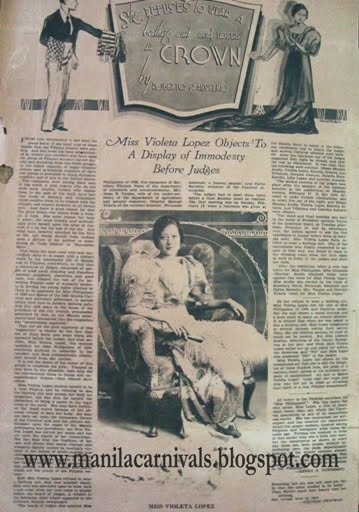
The Tribune, in an article entitled, “She Refuses to Wear a Bathing Suit and Loses A Crown”, was profuse with praise for its candidate: “Miss Violeta Lopez has shown by this exceptional act that she is still the daughter of these Sunkist Isles, the pride of a nation’s heart, strong in the inviolate modesty of maidenhood. All hail to Queen Violeta Lopez! Long may she reign and long may her act be cited as revealing that spirit of a true Filipino womanhood!”.

Eventually, Violeta Lopez would be elected queen of the grand Carnival in Jaro, Iloilo, which rivaled the pageantry of the national Carnival, as eyewitness reports noted. She would also put the bathing suit controversy behind her, returning to the Manila Carnival two years later, where this time, she would win the Miss Mindanao title in the court of the 1932 queen, Emma Zamora.

Saturday, February 7, 2009

62. 1930,THE BATHING SUIT CONTROVERSY II: The Bare Truth

HIS POOL PARTY STARTED IT ALL. Councilor Antonio Torres of Manila hosted a pool party in which the finalists for the 1930 Miss Philippines crown were asked to wear swimsuits--and it was in his home that the controversy began.

Explanatory statements were issued by people involved in the controversy. Antonio Torres, the host of the party had an open letter published in La Vanguardia, in which he said that the party was a social affair, “such as I have celebrated in my swimming tank a number of times, pictures of which parties have been published in the local papers”. He further insinuated that Miss Lopez had not been invited by him to the party. Violeta Lopez counterclaimed that she was asked to go by Rosita Jose, a member of the Carnival Committee, an invitation approved by no less than Carnival Director Arsenio Luz.


Two judges, too, offered their versions of the story. Mrs. Marina Yulo de Vargas testified that “I have not seen Miss Violeta Lopez in a bathing suit nor did she convert her chemise into a bathing suit to take part in the contest on the last day of the selection”. On the other hand, Manuel Yriarte testified that “I have not seen Miss Violeta Lopez for whom I gave my vote as one of those selected”.

Far from clarifying the issue, the statement of Yriarte only served to bolster public opinion that Miss Lopez had indeed been eliminated because of her refusal to don a swimsuit. If she was one of the judges' choice, why was she not in the winners' circle?

OUSTED BUT NOT OUT. Violeta Lopez, candidate of the newspaper "The Tribune", in the eye of the swimsuit storm.

It was then that all five judges (the other three were Secretary of Commerce Filemon Perez, artist Fernando Amorsolo, Arch. Carlos Barretto) issued an official statement that outlined the final selection process:

  1. A series of elimination rounds was used to determine the 1930 Miss Philippines. In the 1st round of voting, 8 passed: Consuelo Acuña, Estrella Alvarez, Rosario Ruiz Zorilla, Luz Villaluna, Violeta Lopez, Corazon Campos, Lourdes Aunario and Nieves Benito.
  2. On Presentation Night, a 2nd round elimination round reduced the eight to four: Acuña, Alvarez, Zorilla and Villaluna. Villaluna and Lopez had tied for the last finalist slot and it was judge Amorsolo who broke the deadlock. Lopez was thus eliminated.
  3. At the home of Mr. Torres, the 4 finalists were invited so the judges can determine their final placements. Acuña got the votes of 4 of the 6 judges. After choosing her as Miss Philippines, the judges voted on Miss Luzon, Miss Visayas and Miss Mindanao and the results were unanimous: Alvarez, Villaluna and Zorilla, in that order.

This official statement clarified Yriarte’s earlier pronouncement that he voted for Miss Lopez on the Presentation Night, which was a prelude to the final judging.

THANK YOU, GIRLS. Lourdes Aunario (El Debate), Lilia Lopez (Atalaya) and Corazon Campos (Philippine Collegian) were among the finalists eliminated during the judges' final deliberation. Campos and Aunario, though out of the running, were invited to the pool party.

But then another question arose: why did 6 candidates show up at the party, instead of 4? Corazon Campos and Lourdes Aunario kept their invitations which they showed to the press. The invitation expressedly had this reminder: “Please do not forget to take with you a bathing suit. You do not need to come elegantly dressed..”. To muddle up the issue further, how come Lopez came and not Aunario? (Aunario had declined the invitation, and that, as earlier mentioned, Lopez came because of Rosita Jose’s invitation).

61. 1930, THE BATHING SUIT CONTROVERSY I: Wear It or Lose It

GALVESTON GIRLS. Beauties from around the world assemble at Galveston, Texas for the International Contest of Beauty and Pulchritude. The Philippines was said to have been invited to field a delegate.

A major uproar in the 1930 Manila Carnival was the so-called ‘bathing suit incident’, a behind-the-contest drama that threatened to cast a shadow on the results of the Miss Philippines search. The controversy lingered even after the contest was over, fanned by newspapers who published different versions of the incident. But the basic account was the same—the six Miss Philippines finalists were invited to a party in the house of Antonio Torres, president of the municipal board of Manila.

STATESIDE BEAUTIES MEET GLOBAL BEAUTIES. Contestants from Europe compteted against state queens from America in this early pageant.

In the said affair, the panel of judges required the finalists to wear swimsuits and those who did not conform to this requirement automatically lost by default. The Philippine Carnival Association had apparently received an invitation from a contest organizer based in Galveston, Texas to field a delegate to the International Contest of Beauty and Pulchritude which had a mandatory swimsuit competition.

MODESTY ASIDE. The mandatory swimsuit segment of the competition triggered the controversy that arose in the 1930 Miss Philippines search. In the eye of the storm was Miss Violeta Lopez, who refused to wear a swimsuit--and was thus, as her supporters claim, eliminated from the royal race.

In the center of the storm was Iloilo belle Violeta Lopez, a strong contender for the title and a candidate of The Tribune, who eventually dashed all hopes of winning when she flatly refused to wear a swim suit. For this act, she was both praised and twitted, and a flurry of claims and counterclaims were hurled from both sides—Violeta’s relatives and supporters and the officials and judges of the Carnival association.

One of the strongest statements of support came from the Catholic Women’s League headed by Mrs. Leonarda Limjap de Ubaldo, who, one can recall was the original 1908 queen-elect who gave up her crown. “In these days of the breakdown of this womanly virtue of modesty, your example will be both an inspiration to all and an incentive to ideals helpful to our nation”.


Nicasio “Nick” Osmeña,
head of the Proclamation Night and the eldest son of President Sergio Osmeña, thought that there was much ado about nothing. “Stories praising Miss Lopez to the skies for refusing to put on a bathing suit are all but applesauce”, he said in a Herald interview, “Beside, she was already out of the running before the party (at Mr. Torres’ house)”. This prompted a cousin of Violeta, Luis J. Lopez to accost Nicasio at the Cine Ideal lobby where reports said he “attacked Nick, cutting his lips”, an incident that Osmeña denied.

Of the statement of Nick Osmeña, Miss Lopez retorted: “I do not know how Mr. Osmeña can pretend to have known what transpired in that party, when he was not even present”. She added that it was not true that she had wanted to wear a bathing suit but could not because she did not have one—she refused to put on one, period. “I never suspected that my refusal to wear a bathing suit would be so capitalized on by the newspapers…and now the facts are being twisted”.

60. 1930 MISS LUZON, MISS VISAYAS, MISS MINDANAO


ESTRELLA ALVAREZ, 1930 Miss LUZON

Estrella was a student of Philippine Women’s College and the candidate of the newspaper, Intelligencer. She comes was from Laoag, Ilocos Norte. She was described as being “more mestiza” than Monina. Years after the Carnival, her kidnapping was reported in the papers.

*****

LUZ VILLALUNA, 1930 Miss VISAYAS

She was Centro Escolar de Señoritas’ reigning Queen of Charity Fair. Luz was described in a Graphic write up as, “most typically Filipina in looks…is one of those women to whom photographs never do justice’.

*****

ROSARIO RUIZ ZORILLA, 1930 Miss MINDANAO

A candidate of the Herald and a student in the College of Law at the University of the Philippines. She did not finish her studies as she married her consort the following year—Rosendo M. Chanco, an advertising executive. Musically inclined, she plays the piano and the violin. There is an intelligent quietness about her, she talks evenly and she was described as " being the best-read among the beauties".

*****