Monday, June 18, 2012
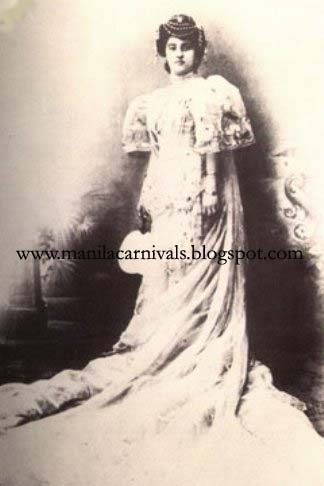
217. 1908 Sultana del Pasig, CONSUELO AGRAVA
The first-ever Manila Carnival of 1908 probably holds the record as the carnival edition with the most number of royal beauties. Not only did the fair had two queens (Pura Villanueva as 'Queen of the Orient' and Marjorie Colton as 'Queen of the Occident'), but each reina had a retinue of at least 12 damas with their own 12 consortes, plus 4 young courtiers or page boys.
Another special title was given to a local beauty to represent the royal realm of Pasig, an important district of Manila on whose land the great and mighty river that dictated the commerce of the land--Rio de Pasig--flowed.
The first Sultana del Pasig, Consuelo Agrava, from the Bureau of Education, was handpicked by city officials for her very apt beauty. She As “El Renacimiento” reported, Miss Agrava, was “truly of the Sultana type, dark, with ojos de sulamita” (eyes of a peaceful woman).
A spectacular float was made by her city exclusively for her, an Oriental pagoda featuring native nymphs positioned up front, in the act of rowing. Over the boat, large “tutubis” or dragonflies hovered around her, coming to life as the carroza was driven at the Hippodrome. At the poopdeck—the topmost part of the float—Consuelo did not sit, but reclined on a lounge—the dramatic pose of the sultana elicited much applause from an awestruck crowd.
After the Carnival hoopla, Consuelo returned to her work as an educator, becoming an active member of the Parent-Teacher's Association (PTA) of Manila where she was, at one time, named as Chairman of the Committee for Entertainment. She married Jose Alvarez Agoncillo with whom she had three offsprings: Antonia, Marina and Francsico.
Tuesday, February 9, 2010
107. DRESSING ROYALTY: Couture & Costumes fit for a Queen

In the 1908 Manila Carnival, the Oriental Queen awed the Carnival audience by coming to her presentation night dressed in a reconfigured baro’t saya. Pura Villanueva’s mother, the highly skilled Emilia Garcia, sewed the unique creation herself, completely removing the panuelo from the ensemble. Fashioned from piña and fine sinamay gauze, the baro’t saya was then meticulously hand-embroidered by Emilia. A clever touch was the use of a Japanese fan as a fashion accessory, a symbol of the queen’s Oriental domain. When Pura showed up for the first time in this outfit, the reception was nothing short of spectacular, and newspaper accounts were one in saying the native wear became her.

On the other hand, the next year’s winner, Julia Agcaoili made a complete turn-around by wearing a Western-inspired dress, an Empire-cut gown that was immensely popular in European countries, but the use of Filipina costumes made their return in the next editions of the Carnival, starting with the 1912 winner, Paz Marquez.

The regional winners wore their titles with pride, most especially the Mindanao muses. As early as 1912, the reynas of Mindanaw came to their coronations garbed as exotic Sultanas and Zoraydas in form fitting outfits matched by their court. Only a few Misses Mindanao winners (1931-1935) continued to adhere to this dressing tradition until the idea was abandoned altogether.

As mentioned earlier, the Coronation motifs were almost always thematic (e.g. 1915-Roman, 1922-Grecian, 1923-Russian, 1925-Egyptian, 1926-Hindu-Arabic, 1930-Siamese). There are pictures of the 1931 winners in Muslim dresses, but these may have been just for one pageant presentation. In 1929, the event had a Sea Fantasy theme complete with a Poseidon character. Pacita delos Reyes wore a Graeco-Roman inspired gown with thousands of seed pearls dangling in front, true to her being a “pearl of the Orient Seas”. All these elaborate costumings were to give way to more traditional dresses in subsequent Carnival outings.

In 1926 and 1927, when minority candidates from the North and South came to compete in Manila, they made clear to the crowds their provinces of origin by coming in regional ethnic costumes.The 1927 Miss Mountain Province, Juliet Linney and Miss Baguio Beatrice Sanup came in Igorot costumes, made of indigenous woven fabric. Scott Rasul (1926 Miss Sulu), Bala Amai Miring (1926 Miss Lanao), Manuki Makarimbang (1927 Miss Lanao) wore colorful malongs.

The 1927 Miss Mindanao winner, Nora Maulana of Sulu, stood out during the Coronation Night, resplendent in a Muslim costume and looking very much like a Mindanao princess. While the rest of the winners had flowing serpentina trains, she had a shimmering printed skirt that ended at her ankles. Her other official pictures show her in batik tops with rich with patterns traced in sequins and beads and Muslim-style skirts, with a manton draped over her shoulders.

The 1930s showed the emergence of Philippine haute couture from the atelier of the most eminent designer of the time, Dña Pacita Longos. She revolutionized the terno by removing the tapiz which facilitated mobility of the wearer. For the 1931 Queen, Maria Kalaw, she designed a modern, yet beautiful burnt orange and black terno that wowed the crowds gathered at her presentation at the Carnival Auditorium.
After 1935, fancy costumes were dispensed with altogether, with ladies preferring to don more modernized versions of the terno—some modified in one streamlined piece, others with peplums, fluffed up with petticoats, and embellished with appliqués, ruffles, lace and embroidery.

By 1939, the long, unwieldy train had disappeared altogether with more volume added to the skirt’s silhouette. But sadly, even the sight of fashionable Queens dressed to the nines on their royal thrones and carrozas could save the day for the Manila Carnivals, which, plagued by lackluster support and fundings, were no more by the turn of a new, but turbulent decade.
Tuesday, October 27, 2009
90. THE EXALTATION OF BEAUTY, II
DAUGHTERS OF LUZVIMINDA. Beauties from Luzon (Miss La Union), Visayas (Miss Leyte) and Mindanao (Miss Lanao) converge at the 1927 edition of the Manila Carnival.
Those who were really in a better position to win the crown were daughters of de buena familia families who not only had the financial clout, but who also possessed sterling reputation and spotless character. Indeed, the voting public seemed to have placed a premium on the candidate’s distinguished background over physical beauty if one were to see the early list of winners. It was not necessary to make character investigations as the delegates were often handpicked by provincial officials and came to Manila with the most glowing recommendations.
REDEFINING THE STANDARDS OF BEAUTY. Carmen Papa, who, as one observer noted was "the least attractive, but certainly the gentlest", went on to win the 1925 Carnival Queen title. It also helped that his father, Ramon Papa, was a high profile member of the Philippine Commission.
Such was the case of the early winners like Pura Villanueva, whose feminist writings were already familiar to Manila society even if she wrote for regional newspapers. In 1925, queen-elect Carmen Papa, was described by beauty observers as being the least attractive among the candidates, but certainly “the gentlest”. The next year, when the choice for the Queen vacillated between Anita Noble of Batangas and Carmen Fargas of Zamboanga, the judges finally cast the deciding vote for the candidate with the more distinguished lineage—Anita Noble, who had the illustrious Agoncillos (diplomat Felipe, Maria, wife of Emilio Aguinaldo; Marcela, maker of the Philippine flag) on her bloodline.
Delegates of ethnic descent had slim chances of winning the crown given the stature of their provinces compared to imperial Manila which produced the most number of Carnival Queen winners (8), followed by Batangas with 3 (1913, 1923, 1926) and Iloilo, Bulacan and Pampanga with 2 winners. Even the backgrounds of the two Kapampangan winners were downplayed as Socorro Henson (1926) and Guia Balmori (1938) practically grew up in the city. The 1927 queen, Luisa Fernandez was actually from Tayabas, but represented Manila as she was a student in the city at the time of the contest.
PROMDI QUEEN. Provincial lasses held their own against the more sophiticated beauties from Manila and other key cities. Iloilo was the first province to have a daughter proclaimed as Carnival Queen, but only after the original Manila winner renounced her crown.
One would think that when a panel of judges replaced public subscription voting in 1926, the playing field for all contestants would be levelled. While it was true that Bala Amai Miring (Miss Lanao 1926) and Nora Maulana (Miss Sulu 1927) made it to the royal court as Misses Mindanao, the rules decreed at that time that the regional winners should authentically come from the provinces of Luzon, Visayas and Mindanao. This rule was revoked in 1930, and henceforth, the second, third and fourth placers were named as Miss Luzon, Miss Visayas and Miss Mindanao respectively.
MINDANAO MAIDENS. Nora Maulana and Bala Amai Miring (left and middle) were both named as Miss Mindanao in the 1926 and 1927 Carnival. Rules dictated then that the regional winners should come authentically from the region. No other Mindanao beauty won after the rules changed in 1930, where the regional titles were awarded to the 2nd, 3rd and 4th placers, irregardless of their origins . The third girl is Scott Rasul , Miss Sulu of 1926.
For ‘minority contestants’, the rule change practically reduced the chances of winning to virtually nil, paving the way for more Manileñas to place in the finals. There was quite a dissonance in the victory of Louise Stevens as Miss Mindanao 1931—as she was an American-mestiza and a Manila resident.
ALBAY CARNIVAL QUEEN OF 1935. Teresa Barrenechea. Provincial petit fairs were all the rage in the 1930s, with mini-carnivals staged everywhere from Cebu to Sorsogon, Capiz to Cagayan , Pampanga to Baguio.
The provinces thus, concentrated on their provincial fairs and expositions which, like the Cebu Carnivals, were said to rival the national event in Manila in terms of pomp and pageantry. Provinces like Baguio, Pangasinan, Bulacan, Tarlac, Sorsogon, Capiz and Pampanga held their own spectacular carnivals, electing Queens who did not have to go to Manila to compete for the Miss Philippines title; their royal duties were exclusive to their provinces alone.
Sunday, December 7, 2008
39. 1921, Queen of the Manila Carnival, CARMEN LEGARDA PRIETO
1921 QUEEN OF THE MANILA CARNIVAL. Carmen Prieto y Legarda, a 16 year old beauty from a prominent family in Manila.

Carmencita was the daughter of Mauro Prieto and Consuelo Legarda, both well-known in Philippine elite society. Mauro was a successful executive of La Germinal, the leading cigar factory in the Philippines, and was the president of Congreso Agricola de Filipinas. He had been, in fact, one of the escorts of the first-ever queen, Pura Villanueva. It came as a surprise then that he initially objected to the candidacy of her daughter, finding the 16 year old too young to join an adult event.
Again, it was Manuel L. Quezon, then the Senate President, who came to the rescue. Word was out that a pure Hispaniola candidate was being groomed to win the crown in keeping with the Spanish theme of the Carnival. But the ardent nationalist wanted a Filipina or a mestiza at least, to rule over the festivities. Carmen’s father gave in when the president himself pleaded with him to let his daughter run.

With Quezon's support in place, Carmencita’s victory was sealed. She topped the preliminary contests of 8 periodicals: La Vanguardia. Taliba, Philippine Herald, El Ideal, El Debate, Philippine Herald, Ang Mithi, La Nacion and Confetti. Her nearest rivals were Snrta. Dolores Casanovas, the Spanish community candidate and Nellie Ping, who had the backing of the influential Chinese dailies, Man Ho Po and Kong Li Po as well the moneyed Chinese community of Manila.
In the days leading to the final balloting, more drama unfolded. Candidate Clotilde Blancaflor, who was running sixth, withdrew to marry her beau. Cornelia Lichauco also threw in the towel, saying she had never wanted to run in the first place. When all the votes were tallied on 20 January, Carmen, with the the Bachelor’s Club, Sociedad de Tiro al Blanco, Club Filipino, Philippine Columbian and Bohemian Club behind her—won the 1921 Carnival Queen title with 9,838,300 votes.

The Grand Coronation rites were full of pomp and pageantry unlike any other. The theme of the evening was the “occidentalization of the Islands”. But Carmen and her court opted to wear native Philippine costumes—traje de mestizas. Her mother made her wear family heirloom jewelry, necessitating the hiring of guards to secure and protect her. She wore a choker, studded with pearls and diamonds. Her royal crown was made especially by Carnival Director Jorge Vargas and it featured a brilliant diamond solitaire in the middle.
The evening was pure excitement for the young Carmencita. After the national anthems of Spain, America and the Philippines were played, a hymn to peace was rendered by the Philippine Constabulary Band. And, as she was seated on her throne, Eduardo Ros, playing the role of a Cardinal, crowned Carmen amidst fireworks, music and accolades from the leading poets of her time.

Carmen’s King Consort was the accomplished Dr. Basilio Valdes, already well-known for his medical and military experience here and in Europe. Later, Valdes, who was also a relative, became a Secretary of Defense and a Chief of Staff. A court was assembled to attend to the new queen, and it included Florentina Goyena, Vicenta Osmeña, Benita Bayot, Rosario Legarda (the future wife of Dr. Valdes), Dr. Augusto Cortez, Dr. Francisco Tecson, Dr. Ramon Ongsiako, Jose Araneta, Jose Revilla. One of the prizes Carmen received for her victory was a portrait painting done by Fabian de la Rosa, a close friend of her father. Carmen was toasted with lavish parties by her proud parents and gala affairs were held in her honor by dozens of socio-civic groups and various associations.

When the Carnival year was over, Carmen, together with her cousins, traveled to Europe and took French lessons in Paris. Carmen came home a fulfilled young woman, but chose to live in semi-reclusion. As a result, she married rather late at the age of 33 years old to Ramon Caro. Ramon was the founder of a well-known automotive and electrical firm, Ramcar, which he established in 1919. The couple ran a successful business until her husband died in 1979. The union bore daughter Rosario Agustines, and 2 stepdaughters, Isabel Wilson and Cristina Ozamis.
She suffered a hip injury in the late 1970s, but this did not prevent her from pursuing her various personal interests.
Wednesday, August 20, 2008
14. 1908, A ROYAL CLASH
WHO'S THE FAIRER OF THE TWO? Oriental Queen Pura Villanueva, "this queen will not fade away"-the caption on this photo says.First, there was the question facial beauty. The newspaper El Renacimiento was very vocal about who was the better-looking queen. In one important public appearance of the 2 royals, it observed: “The King and Queen of the Occident were very simple in their attire. Perhaps because they had come from a trip. But they were very ordinary looking, including the members of their court. Not so, however, those of the Orient….Altanera sin pedanteria, augusta sin pretensions, producto su distincion de la sangre y de la cuna” (Highborn but without ostentation, majestic without the pretensions, a product of refinement, in blood and in influence).
Then there was the issue of the Occidental retinue getting preferential treatment. For example, when the royalties arrived at the landing, the cars reserved for the Oriental court where nowhere to be found. Thus, Pura and her King Consort left for the grandstand, unattended.
FAVORED AT THE FAIR? Newspapers reported the preferential treatment accorded to the American queen--from the carriage that was ever-ready to take her to carnival functions to the flowers she received.More discourtesies towards the Oriental Royals were reported with astute observation. El Renacimiento recounted one circumstance: “ When the King of the Occident descended from his carroza, he had a bouquet of flowers for the Queen of the Occident, but not even a leaf for the Queen of the Orient. This was a grave fault and a crass ignorance of the forms of courtesy. A sacrilege to etiquette. Attention is due the Queen, who had graciously accepted them into her country”.
A MONARCH SPURNED. Although they introduced themselves at the Carnival gate as the King and Queen of the Carnival, Pura and Manuel were not immediately let in by the insolent 'portero' who even answered that 'not even Christ can enter without paying the entrance fee'.The final insult was when the King and Queen of the Orient were refused entry into the Carnival fairgrounds. Detained by the guard at the gate, they were asked to pay the entrance fee of P.20 at the gate. El Renacimiento was livid. “Inandita osadia!!! (Such inane audacity!!!) The Orient Monarchs prevented from entering their own kingdom! Is this revolution or anarchy? All these reactions need immediate reparation.”
Pura was not to be cowed. She excused herself from one significant evening ball, alleging an indisposition, and the members of her court followed suit. As a demanded by native decorum, the whole court of honor resigned their positions.
Monday, August 18, 2008
13. 1908, PAGEANT BY THE BAY: The Meeting of Royals
One of the most spectacular ceremonials conceived for the 1908 Carnival was the meeting of the Occidental and the Oriental Queen on the bay of Manila, a "cadena-de-amor" maritime procession meant to symbolize the eternal friendship of two Continents. In the well-choreographed event, royal barges bearing the queens were to arrive simultaneously at the Luneta, to be welcomed in the grandest of styles.
The grand plan was laid out to include a ceremonial boat for the use of the Occidental King, a 15th century "carebela” type, while that of the Oriental King was of Indo-Chinese style. Each will have a throne, where the King will be surrounded by his Court, followed by the beautiful Queens of the Carnival and their courts. The boats will be escorted by decorated launches.
An eyewitness account records the fantastic fluvial pageant of 27 February 1908: “It was about 4:30 o’clock when the King and Queen of the Occident occupied their throne on the stern of the royal barge and gave order for the procession to start. The boat was towed by the launch Isabel. The constabulary band was stationed in the bow of the royal barge and the 9th cavalry trumpeters on the launch.”
The boat left with its distinguished guests on board, trailed by artistically-decorated launches simulating whales, clown heads, pelican and marine creatures. At the entrance of the breakwater, the ritual meeting of royalties happened. This was followed by a display of fireworks, boat whistles and salvos from battleships and the wild acclamations of the people. Then, all proceeded to the landing, where our account continued.
HAPPY LANDING. Queen of the Occident, Marjorie Colton, alighting from the royal barge, welcomed by her royal entourage.
“Thousands of surging humanity crowded along the edge of the Luneta fill, the banks of the inner basin where the landing was o be made, and along the road leading to the Legaspi landing, to get a glimpse of the royal party. Never before had so many people gathered together in this city on any occasion and while it is impossible to state the exact number of people who were on the Luneta and the new-made land, a conservative estimate would be from 80,000 to 100,000”.
The royalties arrived a few minutes after 6 at the pier, where they were received by the Carnival Committee composed of Mayor W.W. Brown, Judge Gilbert, Dr. Reno, Dr. Guerney, Capt. Weigl and Mr. Nolting.
DRIVING MISS MARJORIE. Queen Marjorie and Consort Col. George Langhorne
The two royal couples were escorted to automobiles which were awaiting their arrival and the procession then started for the grandstand on the Luneta. The court rode in stately carriages. During this trip, bright lights were focused on the entire entourage. The Queens stood up in their cars to acknowledge the cheers of the spectators. “Everything looked fairy land, decorations, lights, people, everything.”, a newspaper reported.
At the grandstand fronting the Legazpi Monument, the keys of the City of Manila were given by the Mayor to the foreigners. From there, amidst the sound of trumpets of cavalrymen, the courts filed past to go to their fancy palaces, to meet again at Elks Club and then to the Carnival Hippodrome to start the national ball.
Wednesday, August 13, 2008
12. 1908, Queen of the Occident, MARJORIE RADCLIFFE COLTON
1908 QUEEN OF THE OCCIDENT. Marjorie Radcliffe Colton, of Illinois. Sister of Philippine Collector of Customs, George R. Colton and future governor of Puerto Rico.Little is known about the other queen of the very 1st Manila Carnival of 1908. Elected as the Queen of the Occident (Reina del Occidente), Marjorie Radcliffe Colton was the sister of then Philippine Collector of Customs, George R. Colton (1866-1916). George R. Colton had arrived in the Philippines as a Lt. Colonel of a Nebraska Regiment, then became a Collector of the Port of Iloilo. After his Philippine service, he was appointed as the Governor of Puerto Rico (1909-1913) by U.S. Pres. William H. Taft. The Coltons were originally from Galesburg, Illinois.
Marjorie’s name appeared on the candidates’ list for the Carnival queenship on El Renacimiento, where, with 338 votes, placed her second to the last. But with the pull-out of the leading contenders brought about by the controversial newspaper coupon scam, Marjorie suddenly pushed to the forefront of the race, and eventually captured the title of the Occidental Queen, to reign alongside the Oriental Queen, Pura Villanueva.
ROYAL MATCH. Queen of the Occident, Marjorie Colton with with Col. George T. Langhorne, King of the Occident.Upon their selections, the 2 queens had several private conferences regarding clothes and the selection of their court. As part of her royal wardrobe, Marjorie initially chose a blue colored gown with a velvet cape of the same color. Her maids of honor, who came from distinguished American and Spanish families, were to be dressed in European clothes with wide capes of blue satin.
THE OCCIDENTAL TOURISTS. The court of honor of the Occidental Queen was assembled from prominent American and Spanish residents in the Philippines.Designated as the King of Occident to escort Marjorie was no less than Col. George T. Langhorne, aide de camp of Maj. Gen. Leonard Wood and a Spanish war veteran (he would later wed Mary K. Waller of Chicago). The Occidental retinue included Nina de Lis, Hemphill Irving, Luz Rubio, Alberta Clark, Helen Dorrington, Carrie Angur, Marie Fecket, Harriet O’Brien and Mary Macleod. Their consorts were G. S. O’Reilly, Herbert Glona, Daniel Maloney, Maj. Howland, Capt. Paxton, Hanson E. Ely, Capt. Nuttman, Capt. Weigel, Mr. Bowdith and Mr. Gesler—all Americans living in the Philippines at that time.
Tuesday, August 12, 2008
11. 1908, Queen of the Orient, PURA GARCIA VILLANUEVA, part 2
A ROYAL GATHERING. The King and Queens of the Orient with their corte de honor.With her retinue, she must have been a sight to behold. Newspaper coverages of the Carnival recorded the atmosphere upon her entrance: “ The people were delirious with joy, shouting, “Mabuhay!. Ceaseless clappings, specially for the Queen of the Orient, a fresh flower of the Filipino plant, She was standing up and happily greeting the joyful people. Dressed beautiful and maringal, because she was dressed in the native dress, “bagay sa kahinhinan ng maysuot!’ Most becoming the wearer. Wherever she want, she received acclaim. Everyone admired her beauty, and, to the last minute of her passage down the field, there was endless clapping of hands..”.
Pura turned out to be a perfect Queen for Manila’s first carnival, holding her own against her co-royal. Indeed, as the Carnival came to an end, her newspaper, El Tiempo, concluded: “She was a real enchanting Queen. If she can occupy the throne of the Carnival, she can also that of a nation. Because of her simpatico aspect, she takes with her the love and affection of all her subjects..”
ROYAL FLOAT AT THE LUNETA. One of the floats bearing the 1908 royalties of the Manila Carnival wends its way around Wallace Field as an adoring audience waved, clapped and shouted, "Mabuhay!"With the Carnival now behind her, Pura continued on with her social activities. Friendship had grown between her and El Renacimiento editor Teodoro Kalaw of Batangas after their first meeting at a 1907 event at the Centro Escolar de Senoritas. Pura had been an invited lecturer there, and Teodoro found himself smitten by the Ilongga beauty. But the Manila Carnival had intervened before anything could happen. However, his courtship resumed and two years after, on 6 May 1910, Pura Villanueva and Teodoro Kalaw were wed in simple rites at the Molo Church.
After their wedding, the two moved to Lipa, hometown of Teodoro, and finally to Manila, where they settled to raise their fine family: Maria (herself, a Carnival Queen in 1931 and a future Senator), Teodoro Jr. (husband of senator Eva Estrada), Purita (Mrs. Rafael Ledesma) and Evelina (Mrs. Aaron Pines).
STILL QUEEN OF THE HOUSE. Pura, in her later years, with husband, Teodoro Kalaw and 4 children: Maria (future Carnival Queen of 1931), Teodoro Jr., Purita and Evelina.Pura turned out to be a supportive wife to Teodoro in his multi-facetted career as a journalist and as a government executive (Secretary of Interior, Director of National Library, Chairman of the Commission on Philippine Independence.) With her real estate investments, she also established a successful business on her own. Pura’s advocacies too, are legendary. She engaged in many socio-civic activities, founded a school, became a woman’s suffrage champion and earned a Presidential Award of Merit from Pres. Elpidio Quirino in 1951.
The most accomplished woman ever to emerge from the Manila Carnivals—“pioneer for women’s political and property rights, writer, beauty queen, businesswoman, exemplary wife and mother”--passed away on 21 March 1954, aged 67.
Monday, August 11, 2008
10. 1908, Queen of the Orient, PURA GARCIA VILLANUEVA, part 1
REINA DEL ORIENTE 1908. Pura Villanueva y Garcia, of Molo, Iloilo at her coronation. A Filipino-Spanish mestiza, Pura was known for her literary works in Spanish before she was invited to participate in the carnival queen quest.Pura Villanueva was already acclaimed as a ‘beauty with brains’ even before she became a Carnival candidate. In her hometown, Molo in Iloilo, she had established herself as a Spanish writer of repute for El Tiempo, a leading newspaper. Here, she contributed literary articles and insightful essays, mostly on feminine issues. She was also the founder of the Asociacion Femenista Ilonga, a woman’s group. When the first Carnival needed a queen, Carnival officials immediately enlisted her.
HER ROYAL VESTMENTS. As she appeared in her official portrait sitting, dressed in a "panuelo-less" costume designed and executed by her Spanish mother, Emilia Garcia. She holds Japanese fan to symbolize her queenship of the Orient.Pura was born on 27 August 1886 to lawyer Emilio Villanueva and Emilia Garcia—a Spanish girl from Palencia. Emilio had met the 15 year old girl while a student of the University of Salamanca, freely associating with expatriated Filipinos like Graciano Lopez Jaena, Marcelo H. Del Pilar and Jose Rizal. The couple went back to the Philippines to start and raise a family. They were to have two daughters, the elder Maria and Pura, or Purita.
As a youngster, Pura enrolled at the local school for girls founded by Maestra Vitang and then went became an intern at the Sta. Catalina College in Manila. Purita stood out with not only because she was amestizada, fair and tall, but also because she had a strong personality, never timid or modest , was the manner of ladies then. By the time she was 18, she was the toast of Iloilo’s social set, known for her incisive write-ups as a social reporter for the local daily.
CROWNED FOR THE CARNAVAL. Another picture of Pura resplendent in her coronation attire. From the book, "LEGACY, Pura Villanueva Kalaw: Her Times, Life and Works 1886-1954, by Maria Kalaw Katigbak. Publisher: Filipinas Foundation, Inc. (c) 1983.Her elevation to the Queenship was fraught with complications, as discussed earlier, but when Pura finally made up her mind to accept the offer of taking over the vacated throne, she did so with a firm commitment . “I am very happy that I have been chosen Queen of the Orient”, she said when asked for a message to the people of Manila. “I shall try to perform my duties in a way that shall please everyone”.
DAMAS Y CABALLEROS. Pura's court of honor included a dozen or so ladies and swains of prominence who accompanied her at her official functions. She was escorted by King of the Orient Manuel Gomez, an executive of La Germinal Cigar Factory who was dressed as a maharajah.Fetched from Iloilo on a special boat, Pura reigned over the Carnival together with the Queen of the Occident, Marjorie Colton. Her King Consort was Manuel Gomez, an executive from La Germinal. (Mauro Prieto, Tomas del Rosario were previous choices). Queen Pura’s maids of honor were Fe Escurdia, Luz Hugo, Esperanza Poblete, Cirila Legarda, Rosario Gomez, Carmen Gonzales, Antonia Fuster, Luisa Hernandez, Elisa and Purificacion Tempongko, Ramona and Rosa Ponce de Leon. Their courtiers were Feliciano Basa Jr., Emilio Veloso, Juan Zalvidea, Clodualdo Tempongko and Emilio Mapua.
COVER GIRL. Queen Pura, on the cover of a popular local newspaper, Lipang Kalabaw. The papers had a heyday reporting the on-goings of the Carnival.It was reported that the Queen of the Orient “will be dressed in a red mestiza dress of native material, with veil and crown, and decorations of natural flowers”. Instead, for her coronation, Pura wore a native costume made by her own mother—minus the panuelo. It was made of piña cloth and fine sinamay gauze, then hand embroidered. Instead of an ostrich feather fan, she held a Japanese fan to highlight her sovereignty over the Orient.
ROYAL PAIR. The King and Queen of the Orient, surrounded by a retinue of princes, just part of a royal court that numbered all of 24!Pura created quite a sensation when she arrived at the grandstand. An eyewitness report published on El Renacimiento enthused: “The Queen of the Orient, standing up in her car, and waving her handkerchief in answer to the enthusiastic cries of the crowd delirious with joy, was easily the most simpatico figure of the royal cavalcade. Dignified without descending from her rank..she had in her the beautiful amalgam mixture of the aristocratic and of the affectionate towards her people”.
Alongside the august King of the Orient who was arrayed as an Indian Maharajah in blue velvet, Pura, the Queen of the Orient “carried the recopilacion of all Oriental dresses, luxuriously costumed, beautiful and resplendent in her dignity..”
Thursday, August 7, 2008
9. 1908, QUEENS OF THE ORIENT AND THE OCCIDENT
Monday, August 4, 2008
8. 1908, LEONARDA LIMJAP: A Royal Resignation
LEONARDA LIMJAP, the first 'Reina del Oriente' of the 1908 Manila Carnival, abdicated her throne in favor of a family trip to Japan. Here, she stands on the fair left, together with sister Esperanza (middle, future wife of Pres. Sergio Osmena). Seated is her mother, Maria Limjap.To ensure that only “quality” candidates signed up for the queenship of the first Manila Carnival, W. Cameron Forbes began approaching prominent pater familias with daughters of suitable age. One such person he met was Don Mariano Limjap, an immensely affluent Chinese-Filipino businessman from Legaspi who helped finance the Revolution. Forbes persuaded the patriot to allow one of his daughters– the accomplished Leonarda Limjap--to participate in the Carnival, but the Don replied that “he did not want to be talked about”.
DON MARIANO LIMJAP. Prominent Filipino-Chinese patriot and the reluctant father of the Queen-elect, Leonarda Limjap.With or without his permission, Leonarda’s candidacy was announced in the papers, and the votes she amassed were a testament to her popularity and influence, with many answering the call to “rally to her beauty, dignity and patriotism”. Only 17 years old, Nena finished high school at the Assumption College and became a pupil of the arts. She studied painting under Fabian de la Rosa and piano under Dna. Ventura Galvez. Likewise, she excelled in the sports of tennis and fencing. A well-travelled girl, Nena has journeyed to Europe in the company of her governess, covering Paris, London, Rome Madrid and other major European cities. It was also her dream to visit all the islands of the Philippines to know her country better.
With sterling credentials such as these, it was no wonder that Nena led Filipina candidates all the way in the quest for the Oriental Queen title. But in the midst of the newspaper scandal, the voting was suspended and instead, the final selection process was thrust in the hands of the members of the Philippine Assembly.
On 13 January 1908, the Philippine Assembly cast their votes and of the 69 votes tallied, 39 were in favor of Leonarda Limjap, beating other distinguished ladies like Purita Villanueva, Carmen Francia, Dolores de Morio, Paz Yangko and Inocencia Reyes. Leonarda Limjap had won the 1908 Reina del Oriente crown of the 1st ever Manila Carnival. The newspapers rushed to print her sensational victory and congratulatory accolades pured in. “We congratulate her sincerely”, the leading newspaper El Renacimiento proclaimed, “the Assembly chose a worthy queen to wear the crown of the Queen of the Orient”.
But alas, hardly had the ink on the papers dried out when Nena shocked the Carnival Committee and the Philippine Assembly that had chosen her by renouncing the honor and declining the queenship. Her reason was that she was traveling to Japan for a month in the company of Mr. Regidor and his daughter and further expressed that “she does not want to miss the opportunity to travel in the company of such a nice family”.
THE ROLE OF THE 1st RUNNER UP IS VERY IMPORTANT. The Queen of Iloilo took over the throne and the title refused by Leonarda Limjap who cited a trip to Japan as her reason. Pura Villanueva had consistently ranked 2nd after Leonarda in the counting.With just a few days to go before the opening of the Carnival, the title was offered to the reigning Queen of Iloilo who had placed a strong second to Leonarda: Purita Villanueva. A telegram was quickly dispatched to Iloilo, but Pura initially declined the proposal, preferring to represent her province. A day later, she relented and accepted her appointment with grace.
At last, the Carnival has found its Oriental Queen: Pura Villanueva y Garcia.
Long live the Queen!
(POSTSCRIPT: Leonarda Limjap married Aristeo Rizal Ubaldo, the son of Olimpia Rizal, Jose Rizal's sister. They had 4 daughters. Her sister, Esperanza, would eventually marry Sergio Osmena and become a First Lady of the Philippines. )
Many thanks to Mr. Joey Tirona, grandson of Leonarda Limjap, for the use of the Limjap family photo. Likewise to Mr. Raul Boncan)