Showing posts with label Julia Agcaoili. Show all posts

Wednesday, March 13, 2024

277. 1909 Queen of the Occident: HELEN MINOR DORRINGTON


1909 QUEEN OF THE OCCIDENT, HELEN DORRINGTON 

The quest for dual queens to rule over the festivities of the national fair was continued when the 2nd edition of the Manila Carnival went underway in 1909. There was no problem with the search for the Oriental Queen as there were so many qualified beauties to choose from--the Ilocana Julia Agcaoili was elected to reign as the native sovereign. Finding the Occidental Queen to succeed Marjorie Colton was more challenging as there were few American misses around at that time.


To make the lives of the carnival organizers easier, one of the ladies in Miss Colton’s 1908s court was quickly handpicked to take over her throne—Nebraska-born Helen Minor Dorrington (b. 5 Aug. 1888/ d. 5 Mar. 1984). The 21-year old beauty came from a family of impeccable pedigree, the daughter of Col. Lafayette Albert Dorrington (b. Feb. 1864/ d. 8 Oct.1934), a Spanish-American War veteran.


He had served as the government receiver of land in Chadron, back  in 1888, when the government opened up the Sioux Indian lands for homesteading. Entering the Spanish-American War, he served as a first lieutenant in the 34th infantry and later in the Philippine-American War, where he commanded a group of 50 male scouts.


After the war, and upon the establishment of the civil government in 1900, Dorrington was made the custodian of all government buildings in Manila. He also was member of the Masonic and Elks lodges in Manila.


Helen’s mother was Cordelia Augusta Minor, a Missouri native (b.12 Jul. 1863/d. 12 Jan. 1957), a direct descendant of Mary Ball, the mother of George Washington, and a member of the Daughters of the American Revolution. She and her husband lived in Manila with their daughter, Helen, for many years, and became a prominent part of the growing American community that regularly took part in social activities and goodwill-building events that included the Manila Carnival.


QUEEN OF THE ORIENT, JULIA AGCAOILI

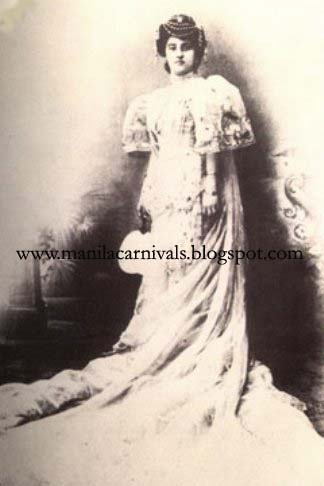
From a member of the 1908 Occidental court, Helen became the Queen of the Occident, reigning alongside the native Queen of the Orient. Not much is known about her reign; one extant picture of her appears on a 1909 Carnival supplement published by Philippine Free Press. It shows a crowned, aristocratic-looking woman with an austere smile, dressed in a glittering gown, and bedecked with jewellery like necklaces and rings.


Four years after her 15 minutes of fame, Helen Dorrington returned to the United States in 1913, following the appointment of her father as chief inspector of the interior department in Washington. It was here that Helen met and married Air Force Col. Henry Clinton Kress Muhlenberg of Missouri (b. 6 Nov 1886/ 20 Dec. 1967). 

HELEN'S HUSBAND, COL. HENRY KRESS MUHLENBERG

The Dorringtons stayed in Washington for twelve years until moving to Sacramento, California in 1925 to establish the Indian Agency. Helen and Henry Kress Muhlenberg would have 2 sons, David, (b.6 May 1914/d. 28 Dec. 2010 ) and John (b.1916), and by 1944 were settled in Vista, San Diego County, along with her mother, Cordelia. David would become an air force colonel like his father, while John made Massachusetts his residence after marriage.


HELEN DORRINGTON'S GRAVE AT ARLINGTON

The elder Dorringtons would make a final move to San Bernardino County, where Helen was widowed in 1967. She would live for 17 more years, before passing away at age 95 in 1984. Like her military parents and husband, they are all buried at the Arlington National Cemetery, in Arlington County, Virginia.


SOURCES:

Philippine Free Press, 1909 Carnival Supplement

Photos: Findagrave, Col. La Fayette A. Dorrington, Cordelia Augusta Minor Dorrington, Helen Dorrington, Col Henry Clinton Kress Muhlenberg

“Indian Affairs Director'sWidow Dies At Age 93”, obituary news of Cordelia Dorrington, The Sacramento Bee, Sacramento, California, 17 Jan. 1957, p. 52.

Tuesday, February 9, 2010

107. DRESSING ROYALTY: Couture & Costumes fit for a Queen

As paragons of Filipina pulchritude, the Queens of the Manila Carnival were also looked at as icons of fashions, and the royal crownings and parades gave their fans the special chance to assess their queens’ sartorial sense. The costumes and fashions of the candidates mirrored the prevailing tastes and social mores of the times, but a few dared to cross the bounds of conventions with creative stylings of our national formal wear.


In the 1908 Manila Carnival, the Oriental Queen awed the Carnival audience by coming to her presentation night dressed in a reconfigured baro’t saya. Pura Villanueva’s mother, the highly skilled Emilia Garcia, sewed the unique creation herself, completely removing the panuelo from the ensemble. Fashioned from piña and fine sinamay gauze, the baro’t saya was then meticulously hand-embroidered by Emilia. A clever touch was the use of a Japanese fan as a fashion accessory, a symbol of the queen’s Oriental domain. When Pura showed up for the first time in this outfit, the reception was nothing short of spectacular, and newspaper accounts were one in saying the native wear became her.


On the other hand, the next year’s winner, Julia Agcaoili made a complete turn-around by wearing a Western-inspired dress, an Empire-cut gown that was immensely popular in European countries, but the use of Filipina costumes made their return in the next editions of the Carnival, starting with the 1912 winner, Paz Marquez.


The regional winners wore their titles with pride, most especially the Mindanao muses. As early as 1912, the reynas of Mindanaw came to their coronations garbed as exotic Sultanas and Zoraydas in form fitting outfits matched by their court. Only a few Misses Mindanao winners (1931-1935) continued to adhere to this dressing tradition until the idea was abandoned altogether.


As mentioned earlier, the Coronation motifs were almost always thematic (e.g. 1915-Roman, 1922-Grecian, 1923-Russian, 1925-Egyptian, 1926-Hindu-Arabic, 1930-Siamese). There are pictures of the 1931 winners in Muslim dresses, but these may have been just for one pageant presentation. In 1929, the event had a Sea Fantasy theme complete with a Poseidon character. Pacita delos Reyes wore a Graeco-Roman inspired gown with thousands of seed pearls dangling in front, true to her being a “pearl of the Orient Seas”. All these elaborate costumings were to give way to more traditional dresses in subsequent Carnival outings.


In 1926 and 1927, when minority candidates from the North and South came to compete in Manila, they made clear to the crowds their provinces of origin by coming in regional ethnic costumes.The 1927 Miss Mountain Province, Juliet Linney and Miss Baguio Beatrice Sanup came in Igorot costumes, made of indigenous woven fabric. Scott Rasul (1926 Miss Sulu), Bala Amai Miring (1926 Miss Lanao), Manuki Makarimbang (1927 Miss Lanao) wore colorful malongs.


The 1927 Miss Mindanao winner, Nora Maulana of Sulu, stood out during the Coronation Night, resplendent in a Muslim costume and looking very much like a Mindanao princess. While the rest of the winners had flowing serpentina trains, she had a shimmering printed skirt that ended at her ankles. Her other official pictures show her in batik tops with rich with patterns traced in sequins and beads and Muslim-style skirts, with a manton draped over her shoulders.


The 1930s showed the emergence of Philippine haute couture from the atelier of the most eminent designer of the time, Dña Pacita Longos. She revolutionized the terno by removing the tapiz which facilitated mobility of the wearer. For the 1931 Queen, Maria Kalaw, she designed a modern, yet beautiful burnt orange and black terno that wowed the crowds gathered at her presentation at the Carnival Auditorium.

After 1935, fancy costumes were dispensed with altogether, with ladies preferring to don more modernized versions of the terno—some modified in one streamlined piece, others with peplums, fluffed up with petticoats, and embellished with appliqués, ruffles, lace and embroidery.


By 1939, the long, unwieldy train had disappeared altogether with more volume added to the skirt’s silhouette. But sadly, even the sight of fashionable Queens dressed to the nines on their royal thrones and carrozas could save the day for the Manila Carnivals, which, plagued by lackluster support and fundings, were no more by the turn of a new, but turbulent decade.

Sunday, August 31, 2008

18. 1909, Queen of the Manila Carnival, JULIA GUERRERO AGCAOILI


1909 QUEEN OF THE MANILA CARNIVAL. Julia Agcaoili y Guerrero, the pride of Ilocos Norte, was gifted with vocal and musical talents.

The Queen of the Manila Carnival of 1909 comes from the most prominent family of Ilocos Norte—the Agcaoilis. Julia Agcaoli’s father was Julio Agcaoli, the 1st ever governor of Ilocos Norte, elected during the American Occupation and a good friend of then Governor-General William Howard Taft. Her mother was Ruperta Guerrero, a Spanish mestiza.

ILOCANA BELLE. The young Julia Agcaoili liked to perform for visitors at their Ilocos mansion, often playing the harp and piano, together with his musically-inclined siblings.

Julia was the fourth in a brood of 12 children, and her schooling was very traditional, spent in a convent school and taught by nuns the fine art of music in which she excelled. Not only did she play the harp and piano, but also sang beautifully. In fact, most of her siblings had strong artistic inclinations that the family often held gatherings in which honored guests from Manila would come and be regaled with their music, song and poetry.

NAGPINTAS TI REINA! Julia wore a more contemporary empress-style gown, richly emboroidered and trimmed with beads. She held an ivory scepter and a crown symbolic of her queenship.

When the Carnival season came around, Julia, who had just turned 20, became a frontrunner for the queenship. Petite and well-mannered, with prominent cheekbones and dark eyes, Julia was a sure bet to win the crown. When she did win, she was besieged by male admirers, and her father was forced to appoint Julia’s brother, Francisco, as her consort.

SIBLING ACT: Queen Julia was escorted to her coronation night by her own brother, Francisco, who also acted as a guard against her overzealous admirers.

At her lavish coronation, the Ilocano belle opted to be gowned in an empire-cut dress of sheer net, over taffeta, with gold and silver thread. Embellished with rhinestones and sequins. She wore a small crown and held an ivory scepter as emblems of her royal authority. Her corte de honor included a dozen prince and princesses, all from well-known families.

THE ROYAL COURT OF THE MANILA CARNIVAL OF 1909 with Queen Julia I.


Julia had a marvelous time during her reign, but the year after proved to be more fulfilling for her. She married longtime suitor Jose Martinez, a Spanish mestizo from Laoag. His father had been sent by the Spanish government to head the Tabacalera in Vintar, and had married an Ilocana. Jose proved to be just as accomplished like his father-in-law. He was named as the 1st governor of the newly-formed Mountain Province and later assumed the post of a Philippine National Bank manager in Cebu. The Martinezes fell in love with the place and settled there. After his government service, Jose continued his banking work by establishing and heading the Insular Bank of Cebu.

Julia bore 10 children in all. Her 8th daughter, Teresita, went on to become a post-war Miss Cebu. Two sons became Jesuits—the eldest Francisco and the younger Jose Jr. who perished in a plane crash en route to Boy Scouts World Jamboree in Athens as part of the Philippine delegation. Another daughter, Manuela Maxima, became a nun. Their other children were Julio, Maria, Jesus, Angel Ruben, Ruperta.

JULIA'S JOY. Mementos of Julia's reign are on exhibit at the Piddig Museum in Ilocos.

Julia died after the end of World War II on 8 August 1945, of a bone disease that had plagued her in childhood. Jose, her husband, outlived her for 17 years, passing away in 1962. In the Piddig Museum today, mementos of her reign are on display to remind visitors of the life and times of one illustrious Ilocana who once ruled over the second edition of Asia’s most awaited spectacle—the 1909 Manila Carnival.