Tuesday, February 3, 2009

52. 1926, CANDIDATES OF THE 1ST NATIONAL BEAUTY CONTEST

THE 1926 BEAUTIES OF THE PHILIPPINES. A record number of 37 contestants, from Ilocos Norte to Sulu, were fielded by their provinces to the 1st ever National Beauty Contest of the Manila Carnival.


MISS AGUSAN: Leonila Reyes
MISS ALBAY:
MISS BAGUIO:
Cristina Victoria
MISS BATAAN: Rosa Reyes
MISS BATANGAS: Anita Noble
MISS BOHOL: Ascension Gaviola
MISS BUKIDNON: Isabel Melendez
MISS BULACAN: Leonor Reyes
(from Malolos, Bulacan, a teacher all her life. She died single, 27 Feb. 2006 at age 96)
MISS CAMARINES SUR: Andrea Baduria
MISS CAPIZ: Rosario Picazo
MISS CEBU:
MISS DAVAO:
Lucille Maxey
MISS ILOCOS NORTE:
MISS ILOCOS SUR:
Rosario Cadiz
MISS ILOILO: Aida Kilayko
MISS ISABELA: Ernestina Pardel Nieto
MISS LAGUNA: Loreto Relova
MISS LANAO: Bala Amai Miring
MISS LA UNION: Manuela Ortega
MISS LEYTE:
Aurora Reyes
MISS MANILA: Rosario Genato
MISS MARINDUQUE: Rosario Cayetano
MISS MASBATE:
Elia Sanchez
MISS MISAMIS: Amparo Nery
MISS NEGROS OCCIDENTAL: Margarita Lacson
MISS NUEVA ECIJA:
MISS NUEVA VIZCAYA:
Martha Maddela
MISS PALAWAN: Carmen Fernandez
MISS PAMPANGA: Rosario Panganiban
(became the wife of film director Vicente Salumbides, starred in some of his movies like "Miracle of Love")
MISS PANGASINAN: Corazon Sison
MISS RIZAL: Remedios Santos
MISS ROMBLON:
MISS SULU:
Scott Rasul
MISS SURIGAO: Sol Soriano
MISS TARLAC: Isolina Palma
(daughter of Genoveva Puno and Gregorio Palma, former Bacolor mayor. Married Dr. Valeriano Calma Ph.D. in agriculture and agronomy. Settled in Los Banos, Laguna)
MISS TAYABAS: Nita San Agustin
MISS ZAMBOANGA:
Carmen Fargas

(*Thanks to Mr. Roland Lorenzo Maddela for providing the name of the 1926 Miss Nueva Vizcaya)

51. 1926, MISS LUZON, MISS VISAYAS, MISS MINDANAO


ROSARIO GENATO, Miss Manila

1926 MISS LUZON


***


AURORA REYES, Miss Samar

1926 MISS VISAYAS

Aurora Reyes of Samar was the daughter of Ricardo Fuentes Reyes, a mestizo, whose father, Don Andres Reyes came from Cadiz, Spain. She will always be remembered as the 2nd wife of the great Filipino statesman, jurist, parliamentarian, politician Claro Mayo Recto (divorced from 1st wife was Angeles Silos). Aurora and Claro had two sons, Rafael and Clarito. Rafael is the father of former senator Ralph Recto.


****


BALA AMAI MIRING, Miss Lanao

1926 MISS MINDANAO


***

Tuesday, January 27, 2009

50. 1926, Miss Pearl of the Orient Seas, CARMEN FARGAS

THE PEARL OF THE ORIENT SEAS. Carmen Caguiat Fargas, 1926 Miss Zamboanga. She gave the 1st Miss Philippines, Anita Noble, a stiff fight in the 1st National Beauty Contest of the Manila Carnival, that judges gave her a special title.

In 1926, the 1st National Beauty Contest was started, as a parallel pageant to the Manila Carnival Queen search. It was the first truly national quest for a queen as provincial representatives, each wearing the sash of their province, came to Manila to vie for the title of "Miss Philippines". It was also different in that, unlike Manila Carnival Queen which relied on public balloting, the selection was done by a panel of judges.


From Zamboanga came Carmen "Carmencita" Fargas, a mestiza beauty born on 16 January 1908 and bred in Aplaya, Ayala in Zamboanga. She was a student of Normal College when the contest beckoned, and was installed as an early favorite as the elected 1926 Miss Zamboanga. She found stiff competition from the 1926 Miss Batangas, Anita Noble, whose lineage included patriots and heroes from both sides of her family. But Carmen held her own, and as the judging reached its final stages, she found herself on top of the judges' list, a major contender for the crown.


In the first ballotting, the regional winners were easily determined, but it was a deadlocked tie for the Miss Philippines crown--between Carmen and Anita. A 2nd balloting did not resolve the issue, and it was only past midnight when Pres. Manuel L. Quezon stepped in and offered suggestions to the tired judges for a quicker resolution to the problem. As related in the previous entry, a final scrutiny of the contestants was done, this time with another judge added.


Thus, it was in this manner that the tie was broken--with Anita Noble pipping Carmen and emerging as Miss Philippines of the 1st National Beauty Contest. But so keen was the competition till the last minute that a special title --"Miss Pearl of the Orient Seas" (Perlas ng Silangan) was awarded to the equally deserving Carmen. At the proclamation of Miss Philippines, the Pearl of the Orient Seas also had her rightful place of honor. In the entire history of the annual Carnival, the 1926 edition was the only one that had 3 beautiful muses reigning together.


After the contest, Carmen went back to her schooling but her life was never to be the same again. Back in Zamboanga, she was caught in a whirl of activities-- attending provincial functions, crowning petit fair queens and participating in Rizal Day festivities. As Miss Zamboanga, she was succeeded by Manolita Villaescosa.
MISS PEARL OF THE ORIENT SEAS WITH MISS VISAYAS 1926, Carmen Fargas (1926 Miss Zamboanga) and Aurora Reyes (1926 Miss Samar)
Carmen managed to finish school and in her later life, she married Dr. Herminio Caguiat. Carmen was a whiz in the kitchen, both as a baker and cook. She was fond of Cadbury chocolates and enjoyed ice cream all her life. The beauty who almost became our 1st Miss Philippines passed away on 4 October 2004.


49. 1926, Miss Philippines of the Manila Carnival, ANITA AGONCILLO NOBLE

THE FIRST MISS PHILIPPINES. 20 year old Anita Agoncillo Noble of Lemery, Batangas, chosen at the 1st National Beauty Contest of 1926. Anita comes from a distinguished family of patriots and revolutionists.

The 1st National Beauty Contest search for the first Miss Philippines was launched with much fanfare and was met with resounding approval by provincial authorities. Quickly, municipalities conducted their own “Miss”, from among whom a provincial bet to the national contest was chosen. Batangas Governor Modesto Castillo however, already had a perfect candidate in mind, so he scrapped the local tilt and named his beauty of choice. No one criticized this arbitrary move, as his decision was met with unanimous approval. Anita Noble y Agoncillo of Lemery was named as “Miss Batangas” and was sent off immediately to the national contest.

MISS PHILIPPINES, 1st National Beauty Contest Winner. All official pictures of Anita as Miss Philippines show her crown-less. She reigned alongside the last Queen of the Manila Carnival, Socorro Henson of Pampanga.

Anita was the middle child and only daughter of Leoncio Noble and Maria Agoncillo, who, in turn come from distinguished families of Lemery. Leoncio managed the family estate in the Lemery-Taal area, while Maria was directly related to patriots Felipe Agoncillo, diplomat of the 1st Philippine Republic, Maria, 2nd wife of Emilio Aguinaldo, and Marcela, maker of the 1st Philippine flag.

Anita had two other siblings: Froilan and Vicente. When it was time for their higher education, the boys were sent to San Juan de Letran, while Anita was accepted as an interna at the nearby Santa Rosa College. It was indeed a surprise, that given her strict upbringing, her parents allowed her to participate in the contest. But inasmuch as she was always in the company of other girls and their chaperones, she was allowed to participate in the contest activities.

BELLE FROM BATANGAS. Another official photograph of Anita Noble as Miss Philippines. Curiously, she is the only queen of the Manila Carnival who never wore a crown in her photo sittings.

During the contest proper, she stayed in the home of Mr. and Mrs. Alfredo Roa Sr., together with Remedios Santos (Miss Rizal) and Amparo Neri (Miss Misamis). Mrs. Conchita Zamora Roa was their official chaperone. One of the most memorable event was a tea dance party given by the Bachelors’ Club to the candidates at the Hotel de Francia along Avenida Rizal. The candidates were paraded in the evening in decorated automobiles that wended its way around Rizal, Escolta, Taft Avenue and ending at the Manila Grand Carnival auditorium at the Luneta. Alighting from the cars, the candidates boarded individual wheeled chariots bearing the name of their respective provinces. Before an adoring crowd and a panel of judges, the candidates were thus presented and voted on.

The selection of the regional winners—Misses Luzon, Visayas and Mindanao—proved to be easy. But the choice for the plum Miss Philippines title ended in a tie between Miss Zamboanga (Carmen Fargas) and Miss Batangas (Anita Noble). Not even a second voting could break the tie. As it was already past midnight, Madame Levy, one of the judges, suggested the postponement of the deliberation for another day. It was then that President Manuel L. Quezon made his appearance. Apprised of the situation, the President invited the contestants the next day at the Manila Hotel. He stipulated that they be dressed in simple baro’t saya and wear no make-up, and that another judge be added to break the deadlock. The judging continued the next day—the girls were judged how they ate lunch!

NOBLE NOBILITY. Miss Philippines-elect Anita Noble, as she appeared in a large 1926 Carnival souvenir photo.


The stringent process finally yielded results with the breaking of the tie. Anita Noble, 20 year old Miss Batangas was chosen as the winner of the First National Beauty Contest. But so tight was the competition, that the Carnival officials decided to create another title for Zamboanga’s Carmen Fargas. She was named as “Miss Pearl of the Orient Seas”. Named as Miss Luzon was won by Rosario Genato (Manila), Miss Visayas was Aurora Reyes (Samar) and Miss Mindanao was Bala Amai Miring (Lanao).

"TALAGANG MAGANDA SIYA". A souvenir photo sent by a certain Polent to Ka Oriang has this dedication on the back: "Bagamat hindi ka nakapanood ng Carnaval ay heto si Miss Philippines at siya ang nanalo sa Beauty Contest, at takagang maganda siya". Dated 14 Feb. 1926.

Our first Miss Philippines was proclaimed with much hoopla in the jampacked Carnival Auditorium. Batangas Assemblyman Antonio de las Alas escorted Anita, the pride of Batangas, to the throne. Leopoldo Kahn stood by as her King Consort. With the dancing ending at 5 a.m., everyone agreed that 1926 was “the liveliest and most successful night in the history of the Carnival”.

Accolades continued to pour in for Anita. Her school presented a musical program in her honor and when she went home to Batangas, her proud province mates gave her a rapturous welcome. She was besieged by admirers but it was not until 9 January 1927 that she met Paris-educated Architect Juan Nakpil, son of revolutionist Don Julio Nakpil and Gregoria de Jesus, the young widow of Andres Bonifacio.

As a graduate student of Harvard where he continued his studies after France, Juan had previously heard of Anita via Carnival news clippings sent to him. Upon his return to the Philippines, Juan met Anita on the feast of the Black Nazarene, in the Quiapo house of his uncle, Dr. Ariston Bautista Lin.

ALL IN THE NAKPIL FAMILY. Anita and Juan had 3 boys in succession: Ariston, Francisco (who had just received their First Communion in this picture), Eulogio (standing in front). Annie sits at the right, and youngest Edith is on her mother's lap. taken in 1936.

Smitten, Juan pursued Anita, often traveling to Lemery every Sunday to woo and visit her. He finally won her on 10 December 1927, and they were wed in the evening highlighted by a reception held at the house of the Batangas Governor. The union bore 5 accomplished children: Ariston, Francisco, Eulogio, Annie (who became Miss Batangas) and Edith (who, too, became Miss Philippines 1955 of the Boys’ Town Carnival).

ANITA'S BOYS. With two of her boys, first-born Ariston and 2nd son Francisco. Still every inch a beauty, Anita was in her late 20s when this picture was taken.
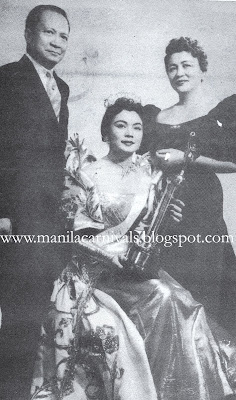
LIKE MOTHER, LIKE DAUGHTER. Daughter Edith Nakpil, like her mother, won the "Miss Philippines 1955" title at the Boys' Town Carnival. Edith is flanked by proud parents, Juan Nakpil and Anita Noble-Nakpil.

In 1973, Arch. Juan Nakpil was conferred the National Artist Award for his valuable contribution to Philippine architecture.Our first Miss Philippines, the accomplished and beautiful Anita Noble, passed away on 14 August 1979, after a bout with cancer.

Wednesday, January 21, 2009

48. 1926, Queen of the Manila Carnival, SOCORRO BORCENA HENSON

1926 QUEEN OF THE MANILA CARNIVAL. Pampanga beauty Soccoro Borcena Henson, a Holy Ghost College student, and the last of the original Carnival queens.


Socorro Henson y Borcena , born on 29 Aug. 1907 in Angeles, is the 1st known Kapampangan beauty to win a national title. She was the eldest of 10 children of Jose Bartolome Henson and Encarnacion Martinez Borcena. Her father, who had a thriving pharmacy business, relocated the family to Intramuros. She attended Assumption, but it was while a student at the Holy Ghost College when the contest beckoned.

CROWNING ACHIEVEMENT. Socorro, crowned with a tiara topped with a distinctive foot-long panache, and dressed in a beaded sari gown.

While the search for Miss Philippines was being conducted in the parallel 1st National Beauty Contest, the quest for the queenship of Manila Carnival was also underway, with Socorro finding herslef at the forefront for the title. In the hotly contested finals, Socorro’s stiffest competitor turned out to be another Kapampangan: Lourdes Luciano y Magdangal of Magalang. But Lourdes gave way to her kabalen by withdrawing graciously from the pageant, so as not to split the judges' votes for the two Kapampangans.

QUEEN OF ARABY. Socorro's coronation motif was Hindu-Arabic, a theme that was carried in her official coronation pictures.

ARABIAN CHIC. Queen Socorro's court of honor at the 1936 Big Carnival, dressed Hindu-Arabic inspired costumes of sari and turbans.

This left the door open for the unrivalled Socorro, she with regal bearing, translucent skin (Col. Antonio Henson, a younger brother, noted that her delicate veins showed through her clear complexion) and a quiet kind of beauty, to clinch the beauty crown, emerging as queen of Manila’s Big Carnival of 1926.

1926 CARNIVAL COURT. Socorro married not her King Consort, but one of her princesses' escort--Francisco Limjap, first young man standing on the left. Francisco was a much-sought after escort, having also been in the court of the 1923 Queen, Neny Apacible, whose brother, Perico, she married.

DAMAS DE REYNA. Socorro, with her two (unidentified) ladies-in-waiting, at an official Carnival function.

Proud neighbors decorated the Solana St. neighborhood with buntings to celebrate her win. Vicente Rufino was her King Consort at her Hindu-Arabic themed coronation, which required her to ride the back of a real elephant to be paraded around the Auditorium. She wore a beaded sari gown and a crorn topped with foot-long panache.

SHEIK MEETS CHIC. The royal duo, Socorro Henson with King Consort, Vicente Rufino, (who would later become a successful businessman with his movie theater seat business).

FILIPINIANA-ATTIRED QUEEN. Socorro dons a traditional baro't saya while escort Vicente Rufino. one of the most eligible bachelors of his time, opts for an American coat tails for this official photo sitting.

In a twist of fate, Socorro ended up marrying one of her damas’ escort—Francisco Limjap y Escolar, from an affluent and influential Manila family. They were married on 26 January 1929. (Francisco’s brother Perico Limjap also married Carnival Queen 1923 Catalina Apacible).

THE LAST CARNIVAL QUEEN. Socorro was famed for her quiet kind of beauty, with a clear complexion and a queenly bearing.

After her marriage, she completed her Home Economics degree at the Holy Ghost College and bore 4 children: Francisco Jr., Baby, Josefina and Ginny. Socorro, died of throat cancer on 2 February 1984, and was interred at the North Cemetery--the last of the original Carnival Queens.

Tuesday, January 20, 2009

47. 1926, MANILA CARNIVAL & THE 1ST NATIONAL BEAUTY CONTEST

TWO FILIPINA QUEENS, ONE CARNIVAL. 1926 brought about major changes in the search for the Carnival royals. Another beauty pageant--the 1st National Beauty Contest--was launched alongside the quest for the Queen of the Manila Carnival, to boost revenues and renewed interest in the annual affair now on its 18th year.

Since 1908, the Queen of the Manila Carnival was elected by public balloting through the various publications of the time. But all that drastically changed in 1926.

To bolster the interest of Filipinos and generate more income for the Carnival coffers, the Philippine Carnival Association announced the creation of a parallel contest, a national beauty contest that would bring out the loveliest Filipinas from all over the country, from among whom the fairest from each region would be chosen and given the titles “Miss Luzon”, “Miss Visayas” and “Miss Mindanao”.

The loveliest of them all would be named as “Miss Philippines”—to be voted on by a panel of qualified judges noted for their social leadership. Culture, intelligence and integrity. In this manner, a true Queen of the Philippines—chosen from the ranks of the islands’ loveliest-- would emerge.

All provincial governors were thus apprised of this new mode of selection so that they could screen contestants in advance. The 1st Beauty Contest would run alongside the search for the 1926 Manila Carnival Queen which was still conducted in the same manner as the years past so as not to surprise the public. While the Carnival Queen had a Coronation Night, Miss Philippines and her court would have a Proclamation Night, in which the entire country would be involved by way of regional representations. In fact, so many came from the different provinces—literally from Aparri to Jolo—that the auditorium, though built larger than in the previous years, could not quite contain the crowd that came on the appointed day.

1926 saw the only time when two Filipina queens reigned over the Carnivals. As such, it was billed as Manila's Big Carnival of 1926. It was not to be repeated again. Although the two pageants shared equal billings, the “1st National Beauty Contest” overshadowed the Manila Carnival Queen quest, by eliciting more public excitement. 1926 would be the last time the title of “Queen of the Manila Carnival” will be given. Henceforth, only the title of “Miss Philippines” would be bestowed to the winners of the succeeding years.

Wednesday, January 14, 2009

46. 1925, Queen of the Manila Carnival, CARMEN AREVALO PAPA

1925 QUEEN OF THE MANILA CARNIVAL. 19 year old Carmen Arevalo Papa of Manila, only daughter of Dr. Ramon R. Papa, member of Quezon's Philippine Mission.

One of the most prominent winners of the Manila Carnivals was Carmen Arevalo Papa, the only daughter of Dr. Ramon R. Papa, who was a member of Quezon’s Philippine Independence Mission to Washington D.C. and Lutgarda Arevalo. Dr. Papa was also a popular figure, well-liked both among the galenos and among the politicians. He owned a range of businesses, running a drug store and several haciendas, and , at one point, was the head of a gold mining firm in central Luzon. Lutgarda died while giving birth to Carmen and an aunt took care of the infant. She grew in comfort, however, staying with his father on San Pedro St., now Evangelista, in Manila.

MOORISH MOTIF. The 1925 Manila Carnival Gate Entrance featured parapets, domes, statues in niches and arches, inspired by Moorish architecture.

THE 1925 CARNIVAL TOWER. A Carnival mainstay is the landmark 6 storey tower. It followed the Moorish design of the main entrance.

On 19 July 1909, Dr. Papa married again, this time to Angela Montenegro. She looked after the motherless baby as if she were her own. Carmen was sent to St. Scholastica’s College and at age 19, she suddenly found herself a leading candidate of the 1925 Manila Carnival. She won the crown, and her stepmother helped her prepare for her night of nights.

CARMEN AS CLEO. The queen of the 1925 Manila Carnival dressed like an alluring Egyptian princess, complete with an asp on her headdress.

WALK LIKE AN EGYPTIAN. Queen Carmen with escort Vicente Mendoza, at the Egyptian-themed coronation ball.

The Coronation motif was Egyptian and Queen Carmen II came as Cleopatra, complete with a crown topped by an asp and “bearing the scepter of Joy and Good Humor”. Her King Consort was Vicente Mendoza, who came dressed as a pharaoh complete with an head dress and ankh staff.

AGE OF PHARAOHS. The royal court of the 1925 Manila Carnival, attired in full Egyptian regalia during the Grand Coronation Night.

The royal court also came in full Egyptian regalia and the effect on the crowd was nothing short of spectacular. In the next balls, Carmen came in traditional baro’t saya that showed her real Filipina beauty.

Two years later, Carmen found herself meeting another Vicente—Vicente Delgado, a young lawyer from a distinguished Cebuano family. Vicente’s father, Tomas Delgado, was a former mayor of Barili, Cebu. The couple were married in a civil ceremony in Baguio on 1 May 1927, and their secret wedding became the buzz of the town and blind items started to appear in leading newspapers about the couple. Vicente left his bride and went back to Cebu to be with his parents. Finally, Carmen and Vicente squelched all rumors by getting married canonically at the San Marcelino Church, 2 months later, on 16 July 1927. (In 1930, their secret wedding was to have negative consequences with regards to family property, resulting in a court case between Carmen and his stepmother, Angela Montenegro).

HER MAJESTY, QUEEN CARMEN II. In one of her official portrait sitting, wearing a traditional Filipina costume and a rhinestone crown.

It was a good thing that Carmen and Vicente decided to live in Cebu, away from the unpleasant feelings the court case brought. From Barili, they moved to Cebu City to raise their 8 children: Lutgarda, Gualberto, Teodoro, Ramon, Milagros, Benjamin, Pacita and Ana Victoria. In later years, because Carmen still had land holdings in Manila, the Papas relocated to Makati to make supervision of their real estate business easier.

CARMEN'S CHARM, captured in a salon photograph, showing the Queen in character as an Egyptian royal.

In her later years, Carmen developed a devotion to Our Lady of Lourdes, even making a pilgrimage to France to seek help for her asthmatic condition. Her ailment grew progressively worse and on 7 June 1970, Carmen Papa, the toast of the 1925 Manila Carnival, died of asthma-induced cardiac complications at age 64.