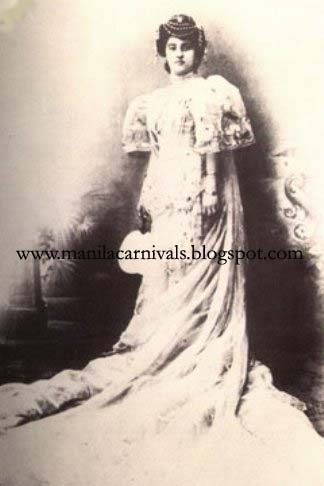
Wednesday, October 2, 2013
260. Post-Carnival Years: MARIA KALAW AT THE PAN-PACIFIC PAGEANT
The Pan-Pacific Pageant was staged during the Commonwealth years as a symbol of goodwill and cooperation between America and its Pacific holdings and territories, including the Philippines. The highlight of the pageant was the ceremonial presentation of flags, carried by representative beauties from America and the Philippines. The Philippines was represented by former Miss Philippines 1931, Maria Kalaw.
Miss Maria Kalaw (right) dressed as Maria Clara presented the Philippine flag on the same occasion.
Miss Anne Alger (left) dressed as Miss Liberty presented the American flag to Gov. Gen. Frank Murphy during the Pan-Pacific Pageant. Alger is a descendant of two U.S. presidents, the Adamses.
Sunday, August 4, 2013
253. Carnival Wedding: KALAW-KATIGBAK NUPTIALS
Maria Kalaw, 1931 Miss Philippines, was wed to Dr. Jose Katigbak on 2 June 1934. Sponsors at the wedding were Ramon Fernandez and Mrs. Francisco Tirona-Benitez, Rafael Corpuz and Mrs. Maximo Kalaw, Vicente Lopez and Mrs. Manuel Roxas, Dr. Baldomero Roxas and Mrs. Emilio Aguinaldo, Dr. Sixto Roxas and Mrs. Justa Kalaw de Katigbak, and Leoncio Aranda and Mrs. Arsenio Luz.
The Katigbak couple went on to raise a brood of 4 that included: Marinela (Nela), Josefina (Pinkie), Purisima (Puri) and Norberto (+Butch).
Monday, March 4, 2013
240. Carnival Wedding: DE SANTOS-MALOLES NUPTIALS
Alicia Cabarrus de Santos was the original Miss Luzon in the court of Maria Kalaw, 1931 Miss Philippines. She had also reigned as the Queen of Charity in her teenage years. At the Manila Carnival, the popular socialite was leading all the way when Kalaw overtook her with a deluge of votes, in the final minutes of the contest.
Declaring foul play, de Santos resigned her post, which Lina Araullo assumed. She remained unperturbed after her not-so-pleasant Carnival experience; her family, in fact, continued to support the Carnival. In the next year’s festivities. Alicia’s doctor-brother, Arturo de Santos, provided escorting duties to Queen Emma Zamora. On 29 August 1934, Alicia married Dr. Octavio L. Maloles at lavish ceremonies held at the Santo Espiritu Church. They had a son, Octavio II.
Tuesday, February 9, 2010
107. DRESSING ROYALTY: Couture & Costumes fit for a Queen

In the 1908 Manila Carnival, the Oriental Queen awed the Carnival audience by coming to her presentation night dressed in a reconfigured baro’t saya. Pura Villanueva’s mother, the highly skilled Emilia Garcia, sewed the unique creation herself, completely removing the panuelo from the ensemble. Fashioned from piña and fine sinamay gauze, the baro’t saya was then meticulously hand-embroidered by Emilia. A clever touch was the use of a Japanese fan as a fashion accessory, a symbol of the queen’s Oriental domain. When Pura showed up for the first time in this outfit, the reception was nothing short of spectacular, and newspaper accounts were one in saying the native wear became her.

On the other hand, the next year’s winner, Julia Agcaoili made a complete turn-around by wearing a Western-inspired dress, an Empire-cut gown that was immensely popular in European countries, but the use of Filipina costumes made their return in the next editions of the Carnival, starting with the 1912 winner, Paz Marquez.

The regional winners wore their titles with pride, most especially the Mindanao muses. As early as 1912, the reynas of Mindanaw came to their coronations garbed as exotic Sultanas and Zoraydas in form fitting outfits matched by their court. Only a few Misses Mindanao winners (1931-1935) continued to adhere to this dressing tradition until the idea was abandoned altogether.

As mentioned earlier, the Coronation motifs were almost always thematic (e.g. 1915-Roman, 1922-Grecian, 1923-Russian, 1925-Egyptian, 1926-Hindu-Arabic, 1930-Siamese). There are pictures of the 1931 winners in Muslim dresses, but these may have been just for one pageant presentation. In 1929, the event had a Sea Fantasy theme complete with a Poseidon character. Pacita delos Reyes wore a Graeco-Roman inspired gown with thousands of seed pearls dangling in front, true to her being a “pearl of the Orient Seas”. All these elaborate costumings were to give way to more traditional dresses in subsequent Carnival outings.

In 1926 and 1927, when minority candidates from the North and South came to compete in Manila, they made clear to the crowds their provinces of origin by coming in regional ethnic costumes.The 1927 Miss Mountain Province, Juliet Linney and Miss Baguio Beatrice Sanup came in Igorot costumes, made of indigenous woven fabric. Scott Rasul (1926 Miss Sulu), Bala Amai Miring (1926 Miss Lanao), Manuki Makarimbang (1927 Miss Lanao) wore colorful malongs.

The 1927 Miss Mindanao winner, Nora Maulana of Sulu, stood out during the Coronation Night, resplendent in a Muslim costume and looking very much like a Mindanao princess. While the rest of the winners had flowing serpentina trains, she had a shimmering printed skirt that ended at her ankles. Her other official pictures show her in batik tops with rich with patterns traced in sequins and beads and Muslim-style skirts, with a manton draped over her shoulders.

The 1930s showed the emergence of Philippine haute couture from the atelier of the most eminent designer of the time, Dña Pacita Longos. She revolutionized the terno by removing the tapiz which facilitated mobility of the wearer. For the 1931 Queen, Maria Kalaw, she designed a modern, yet beautiful burnt orange and black terno that wowed the crowds gathered at her presentation at the Carnival Auditorium.
After 1935, fancy costumes were dispensed with altogether, with ladies preferring to don more modernized versions of the terno—some modified in one streamlined piece, others with peplums, fluffed up with petticoats, and embellished with appliqués, ruffles, lace and embroidery.

By 1939, the long, unwieldy train had disappeared altogether with more volume added to the skirt’s silhouette. But sadly, even the sight of fashionable Queens dressed to the nines on their royal thrones and carrozas could save the day for the Manila Carnivals, which, plagued by lackluster support and fundings, were no more by the turn of a new, but turbulent decade.
Monday, January 4, 2010
99. On the Carnival Runway: FANCY DRESS AND COSTUME CONTESTS

The Carnival beauties, the majestic floats and the spectacular foreworks and light displays were not just the visual stunners that drew crowds and invited rabid participation at the national event. The Fancy Dress Balls and the Costume Contests proved to be one of the more awaited events, a showcase of Filipino creativity at it most imaginative—in which adults and children show off their most original, most fanciful and most outlandish fashion creations in themed fashion competitions, befitting the wild, unbridled carnival atmosphere.

If one were to review the very first Carnival of 1908, it was in fact a one big costume and masquerade ball. The grotesque dances, pageants and processions had participants masked and dressed as harlequins, clowns and allegorical figures. The pageant that involved the Occidental and Oriental royalties featured characters dressed in formal raiments of the richest variety. Following the ceremonies, the evenings were lighted up “to show costumes, masks and masquerades”, leading to the Grand Masquerade Ball of Nations. Ethnic tribes like the participation of the Moros provided much local color, alongside cowboys, military soldiers and Indians.

Prizes were first given to costumed participants on the First Carnival Ball on 5 February 1908. On this night, loving cups were awarded to the most beautiful lady’s costume, the most beautiful gentleman’s costume and to the most attractive group. Gracing the first ever costume ball were the artists of the Italian Opera who happened to be performing in Manila that time. The opera stars regaled the audience when they escorted the Carnival royals to their thrones, wearing their fabulous costumes from the opera Aida.
The succeeding balls were a combination of both a masquerade and costume party, with the traditional unmasking happening at midnight. No one was allowed entrance unless he was suitably garbed in a costume.

In the succeeding Carnivals, children were allowed to compete in a new category called Children’s Fancy Dress Parade. One of the prize winners in the 1916 contest were the Kalaw children, that included the future 1931 Manila Carnival Queen, Maria Villanueva Kalaw. She and her siblings Teodoro and Purita dressed up as Oriental royalties complete with veils and turbans, in costumes made from sinamay, designed by their mother, Pura Villanueva Kalaw.

In the 1922 edition of the Carnival, the sponsored nightly balls also went thematic. For example, the Pan-Pacific Ball required guests to don Hawaiiana costumes. The other Comparsa nights gave prizes not only to costumed revelers but also to the “best impersonators of Clark Gable, Charlie Chaplin and Mae West”.
Towards the end of the Carnival years, the Fancy Costume Balls were tamed down; the last costumed Coronation Night was held in 1932 which had Emma Zamora and her court dressed as exotic Siamese royals. The next year, the Carnival Association eliminated the themed coronation program altogether, but even with costumes or without, the formal coronation rite retained its classy, glamorous style.
Sunday, May 10, 2009
67. 1931, MISS LUZON, MISS VISAYAS, MISS MINDANAO

LINA ARAULLO, 1931 Miss Luzon

*****

LOUISE STEVENS, 1931 Miss Mindanao
Sunday, February 22, 2009
66. 1931, MARIA VS. ALICIA: The Right to Royalty
FACE-OFF: The battle royale for the queenship was contested by Maria Kalaw and Alicia de Santos, who, earlier in the year had reigned as the Queen of Mercy for the Anti-TB program of the government.
FILIPINAS MEETS U.S.A. Maria Kalaw in one of her school pageants wth her American beauty counterpart.Of the 14 Miss Philippines candidates, Alicia de Santos, the candidate of La Opinion, and Maria Kalaw were the ones picked out by newspapers as having the biggest chances of winning the queenship. Based on material wealth, Alicia de Santos seemed to have the upper hand. She was the daughter of Jose Santos and Concepcion Cabarrus, both from affluent Manila families. She had two brothers, Alberto and Arturo. Alicia was also a relative--a cousin, to be exact--of the 1929 Queen, Pacita de los Reyes.
ANTI-TB QUEEN OF MERCY. Alicia de Santos as an advocacy queen for the Philippine anti-TB program.Just like Maria, who had received several beauty citations in school, Alicia’s youthful mestiza beauty was also noticed early. As a student of Holy Ghost College, she was elected Queen of Mercy of the Anti-TB Society of the Philippines in 1929. This high profile event served as a campaign to raise funds for the eradication of tuberculosis—the no. 1 killer disease in the country. Her coronation was attended by the country’s Governor General Dwight Davis, well-known personalities of the American community and top Philippine officials led by Senate Pres. and Mrs. Sergio Osmeña and party. With her beauty in full bloom two years later, Alicia was ready to wear the crown of the country’s fifth Miss Philippines.
QUEEN OF MERCY, Alicia de Santos, at her high-profile coronation with her princesses, attended by high-ranking Philippine and U.S. government officials.But it was clear that Teodoro Kalaw, had also become fascinated with the idea of having her daughter Maria, follow in her mother’s footsteps—a possibility that was also being pointed out by the national media. And so, he mapped out a gameplan to ensure the win of her daughter. To gather votes, he called on his Mason friends and their fraternal networks, asking them and their families to clip coupons, save and submit them for Maria. For days, he would stay in his office and telephone his connections, focusing his attention in getting his daughter elected.
Indeed, on the day of the final counting, Maria Kalaw and Alicia de Santos were ahead of the rest of the contestants. Newspapers had a heyday reporting the neck-and-neck battle between the two beauties: “ Maria Kalaw and Alicia de Santos Fight For Carnival Reign”, one headline ran. “Maria Kalaw or Alicia de Santos? Alicia de Santos or Maria Kalaw?” echoed what the whole of Manila was asking.
On February 4, the partial results were announced on a regular basis:
6 PM : Maria Kalaw = 21,200 votes, Alicia de Santos = 13, 200 votes.
9 PM : Maria Kalaw = 40,000 votes, Alicia de Santos = 22,000 votes
An hour and a half later, the lead had changed:
10:30 PM: Alicia de Santos = 53,100 votes, Maria Kalaw = 49,700 votes
11 PM: Alicia de Santos = 157,000 votes, Maria Kalaw = 151,000 votes
11:30 PM: Alicia de Santos = 618,000 votes, Maria Kalaw = 518,300 votes
With only 30 minutes left, Alicia seemed to enjoy an insurmountable lead. But fifteen minutes before the close of the voting, a group of men entered the hall to drop their stacks and stacks of coupons in favor of Maria Kalaw. A stream of votes for continued to pour for Maria such that at midnight, all her ballot boxes were stuffed to the brim. When the Carnival Director Arsenio Luz and his committee finished the tabulation by 1 a.m. , the results were immediately announced before a roaring crowd of 20,000 people. Miss Philippines of 1931 was Maria Kalaw, Maria I, Maria Primera.
The final tally was 2,516,300 votes for Maria, and 1,450,000 for Alicia. Maria’ lead was an unbelievable and unsurmountable 1 million votes. The official results were too much for the camp of Alicia to bear, who made accusations of ‘trickery”, referring to the Kalaws’ being townmates and close friends of Carnival Director Arsenio Luz.
MISS LUZON, MISSED BEAUTY. Photos of Alicia de Santos as Miss Luzon had already been shot and circulated, only to be withdrawn when she decided not to accept the title. This is the reason why very few of her pictures are available to collectors today.Immediately, Alicia de Santos—the First Princess or Miss Luzon, resigned from her post. But photographs of her identifying her as Miss Luzon had already been printed and released to the public. Lina Araullo took over the vacant position, while Luisa Rodriguez was elevated to the rank of Miss Visayas. American mestiza Louise Stevens was named Miss Mindanao.
Years later, Maria reaffirmed that winning the title was a matter not of popularity but of strategy and effort. “Contests and elections are decided in favor of the better organization, the harder working group. Votes are garnered, they are not cast”.
And what of the controversial Alicia who left the Carnival in a huff? She did not exactly disappear from the limelight. She went on to marry Octavio Maloles Sr., a lawyer. And further to show that the de Santos family had no love lost for the organizers of the Manila Carnival, Alicia’s brother, Dr. Arturo de Santos, agreed to become the King Consort of the 1932 queen, Emma Zamora.
65. 1931, Miss Philippines of the Manila Carnival, MARIA VILLANUEVA KALAW
1931 QUEEN OF THE MANILA CARNIVAL. Maria Villanueva Kalaw will be remembered in the Carnival history as the daughter of the first Queen of the Orient of the Manila Carnival, the accomplished writer, feminist and businesswoman Pura Villanueva.
MARIA AS A YOUNG WOMAN IN 1929. In her teens, Maria was already following in the footsteps of her mother, dabbling in writing for national magazines such as Graphic.At the start, Maria had everything going for her. When her parents were approached by the Carnival organizers to discuss the possibility of their daughter Maria joining the contest, they gave their permission, surprising everyone, including Maria. After all, Pura had not supported her daughter’s candidacy in one beauty tilt sponsored by the Philippine Women’s College, because she was against the fund raising aspect of the contest. On the other hand, it was unthinkable for Teodoro, then director of the National Library, to indulge in vote solicitation for her daughter; he would rather write than socialize.
QUEEN MARIA I. In one of her official portraits as the Queen of the 1931 Manila Carnival.Based on merits alone, Maria, too, was a stand-out. She was born on 14 February 1911 in Manila, the eldest in a brood of 4, that included brother Teddy and sisters Purita and Evelina. Maria’s first Carnival experience was in 1916, when she and her siblings joined—and won the Costume Contest, dressed as Oriental royalties. The children lived a charmed life in their San Marcelino home, where they were sent to the best schools and even traveled abroad with their parents. For her grade school, she attended St. Scholastica, then finished high school at the Philippine Women’s College.
QUEEN OF ARABY. Maria Kalaw came to her Coronation Night in an exotic Arabic costume and a gem-studded helmet-type crown that elicited mixed reactions from the press.For college, she chose to take up philosophy and letters at the University of the Philippines. Like her father, she cultivated a love for journalism and literature, and some of her writings saw print in national magazines such as Graphic and The Literary Apprentice, the school’s premiere magazine. She was involved in almost every major school organization—as a vice president of the UP Women’s Club, member of the Student Council and the UP Writer’s Club.
REINA MARIA PRIMERA. Maria, in full coronation regalia. The U.P. beauty went to school as usual the day after she was elected Miss Philippines.
Of course, Maria’s beauty went unnoticed. She became the muse of the College of Law’s Bachelor Club and a regimental sponsor twice. A reporter from The Independent magazine wrote that “Maria’s beauty was dazzling, her friendliness in full bloom. Nobility is in her gestures and attitude..she seems born to be an Oriental empress”.
MARIA'S NIGHT OF TRIUMPH. An official studio portrait of Maria Kalaw as Miss Philippines 1931.
Entering the national beauty competition, the 19 year-old coed was supported by The Tribune, Philippine Herald, Batikuling and the Philippine Free Press. The rest of the delegates included Lina Araullo, Lourdes Rodriguez, Louise Stevens, Pilar Alberto, Fe Alberto, Rita Panares, Pacita Reyes, Emilia Diago, Celia Acosta, Remedios Manlunas, Gloria Manlunas and Alicia de Santos. Winning depended on getting as many newspaper coupons as possible, published in all the leading dailies and publications of the day. The voting period lasted for 8 weeks, and the tabulation of votes began on 4 February 1941.
MARIA'S COURT OF HONOR. Lina Araullo (elevated to Miss Luzon) and Lourdes Rodriguez (Miss Visayas). Miss Mindanao was yet to be named because of the controversial resignation of Alicia de Santos.
Maria projected an attitude of casual detachment from the day she was named as an official candidate. She attended her classes at U.P. as usual. But then, she won in the most dramatic fashion after a see-saw battle with Alicia de Santos. Her father had been quietly mobilizing his Masonic fraternity brothers to collect and clip newspaper coupons. At the last minute, he had voters cast their ballots, overtaking de Santos, the erstwhile leader, and winning the crown for his daughter Maria with a lead of over a million votes. Alicia de Santos was relegated to 2nd place (Miss Luzon), followed by Lina Araullo (Miss Visayas) and Luisa Rodriguez (Miss Mindanao). With de Santos’s resignation, Araullo and Rodriguez were promoted, with Louise Stevens joining the entourage as Miss Mindanao.
AT HER MAJESTY'S SERVICE. Miss Luzon and Miss Visayas flank their beautiful queen, Maria Kalaw, ready to do her bidding in this photo postacrd.
Maria’s coronation theme was Hindu-Malayan, and for her special moment, she was escorted by her brother Teddy Kalaw, who came dressed as an Indian warrior prince. Maria looked exotic in her white silken gown that had bands of gold all around her skirt. Over her neckline was a gold-embroidered collar, trimmed with tassels. She wore 3 strands of pearls, an armlet of diamonds and a helmet-shaped crown with two dangling pendants and a sunburst gem. For her other appearances in the nightly balls, she wore Filipiniana creations made by the famed couturier, Pacita Longos.
The next day, the new Queen nonchalantly went back to school in her regular white uniform, taking pains to look no different from her classmates. Maria, it seemed, was clearly more into her studies than her fleeting duties as a Carnival royal. Sure enough, after her reign, she went back to school and earned a Barbour scholarship in Ann Arbor, Michigan, where she finished her Master of Arts degree in 1933.
MARIA'S MATRIMONY. Maria Kalaw at her wedding to Dr. Jose Katigbak, a relative from Lipa, Batangas.
A year after her return, she married a fellow Lipeño, Dr. Jose (Pepito) Katigbak, who was also a relative. The Katigbaks came from a clan of political leaders in Lipa, Batangas. Maria and Jose raised four children: Marinela (Nela), Josefina (Pinkie), Purisima (Puri) and Norberto (+Butch). Maria, when not tending her family, was also active in socio-civic movements, like the Girl Scout of the Philippines. In 1948, she was drafted into the Central Committee and later became the national president for 8 years.
BORN TO A ROYAL BREED. Marinela, Josefina, Purisima and Norberto--children of Maria Kalaw and Jose Katigbak.
In 1961, running under the Liberal Party, Maria won a seat in the Senate, jumpstarting her political career. She broke new barriers by going to Beijing and joining a Vietnam Mission. In between her busy schedules, she earned a Ph.D and wrote his parents’ biographies: Few There were (like my Father) in 1974, and Legacy: The Life and Times of Pura Villanueva Kalaw.
SENADORA MARIA-KALAW KATIGBAK. A 1960s picture of the fomrer Miss Philippines-turned politician.
Failing to get re-elected, Maria went back to her writing and became a ‘Checkpoint’ columnist for Manila Times. In 1981, then Pres. Ferdinand Marcos named her as the Chairman of the Board of Review for Motion Pictures and Television and earned a reputation as a tough censor. After the untimely death of her only son Butch, Maria suffered from bouts of depression. Also a diabetic, Maria Kalaw-Katigbak was felled by a series of strokes on 10 December 1992. Her beloved husband, Pepito followed her two years after.
64. 1931, MANILA CARNIVAL
By the 1930s the Manila Carnival had evolved from just being a celebration of the cordial relations between America and the Philippines to a spectacular showcase of a country’s progress under the guidance of its colonizer. It had become like an American country fair—but on a much larger scale, featuring product and agricultural exhibits, sideshows and parades. It was also used to reinvigorate domestic and international tourism, a public relation event for the Philippines in need of drumbeating for its limitless investment possibilities.In 1930, for example, the Philippines enjoyed a bumper crop harvest in rice, coconut, sugar, copra and abaca, and was hardly affected by the Great Depression gripping America. The country’s produce were snapped up by the U.S. market and the increased exports helped maintain the youthful Philippine economy. Though economically, it lagged behind its Asian neighbors, the standard of living and the quality of labor was much higher, with government revenue used more efficiently to benefit the Filipinos people.

It was under this optimistic scenario that the 1931 Manila Carnival unfolded, certainly, the most covered Carnival event in recent years, what with the added drama provided by the Miss Philippines quest, in the Fifth National Beauty Contest.