Showing posts with label Manuel L. Quezon. Show all posts

Thursday, May 3, 2012

211. Carnival Beauties: MISS SAMPALOC 1927 and MISS QUIAPO 1927


In 1927, the Manila Carnival quest for Miss Philippines continued its format of having official provincial delegates for the national contest. While some provincial bets were directly selected by high-ranking officials like the governor or the head of the local Carnival committee, the search for Miss Manila was more systematic. Manila's district heads were mandated to name their own "Miss District" which saw the selection of 17 beauties: Nitang Moreno (Gagalangin), Lourdes Baltazar (Malate), Herminia Guerrero (Malate), Beatriz Concepcion Puzon (Sta. Ana), Presentacion Perez (Singalong), Rosario Flores (Sta. Mesa), Severina Narciso Mendoza (Pandacan), Josefina Conde (San Miguel), Leonila Mat. Castro (Tondo), Evarista Laconico (Trozo), Pacita Legarda (Binondo), Luisa Fernandez (Intramuros), Salud Austria (San Lazaro), Erlinda Villarica (Sta. Cruz), Conchita Tusaon (Sampaloc) and Amparo Trinidad Papa (Quiapo).


The two beauties on this page are the official representatives of Sampaloc and Quiapo, Conchita Tuason and Amparo Papa, respectively. Three finalists were picked from the line-up--Miss Binondo (Pacita Legarda), Miss San Lazaro (Salud Austria) and Miss Intramuros (Luisa Marasigan). Emerging as the overall winner was Luisa Marasigan, who swept competition away by winning two titles--Sultana de Pasig and the top title of Miss Manila. She went on even further in the national competition by winning the plum Miss Philippines 1927 crown, succeeding Anita Noble of Batangas.

Tuesday, January 27, 2009

49. 1926, Miss Philippines of the Manila Carnival, ANITA AGONCILLO NOBLE

THE FIRST MISS PHILIPPINES. 20 year old Anita Agoncillo Noble of Lemery, Batangas, chosen at the 1st National Beauty Contest of 1926. Anita comes from a distinguished family of patriots and revolutionists.

The 1st National Beauty Contest search for the first Miss Philippines was launched with much fanfare and was met with resounding approval by provincial authorities. Quickly, municipalities conducted their own “Miss”, from among whom a provincial bet to the national contest was chosen. Batangas Governor Modesto Castillo however, already had a perfect candidate in mind, so he scrapped the local tilt and named his beauty of choice. No one criticized this arbitrary move, as his decision was met with unanimous approval. Anita Noble y Agoncillo of Lemery was named as “Miss Batangas” and was sent off immediately to the national contest.

MISS PHILIPPINES, 1st National Beauty Contest Winner. All official pictures of Anita as Miss Philippines show her crown-less. She reigned alongside the last Queen of the Manila Carnival, Socorro Henson of Pampanga.

Anita was the middle child and only daughter of Leoncio Noble and Maria Agoncillo, who, in turn come from distinguished families of Lemery. Leoncio managed the family estate in the Lemery-Taal area, while Maria was directly related to patriots Felipe Agoncillo, diplomat of the 1st Philippine Republic, Maria, 2nd wife of Emilio Aguinaldo, and Marcela, maker of the 1st Philippine flag.

Anita had two other siblings: Froilan and Vicente. When it was time for their higher education, the boys were sent to San Juan de Letran, while Anita was accepted as an interna at the nearby Santa Rosa College. It was indeed a surprise, that given her strict upbringing, her parents allowed her to participate in the contest. But inasmuch as she was always in the company of other girls and their chaperones, she was allowed to participate in the contest activities.

BELLE FROM BATANGAS. Another official photograph of Anita Noble as Miss Philippines. Curiously, she is the only queen of the Manila Carnival who never wore a crown in her photo sittings.

During the contest proper, she stayed in the home of Mr. and Mrs. Alfredo Roa Sr., together with Remedios Santos (Miss Rizal) and Amparo Neri (Miss Misamis). Mrs. Conchita Zamora Roa was their official chaperone. One of the most memorable event was a tea dance party given by the Bachelors’ Club to the candidates at the Hotel de Francia along Avenida Rizal. The candidates were paraded in the evening in decorated automobiles that wended its way around Rizal, Escolta, Taft Avenue and ending at the Manila Grand Carnival auditorium at the Luneta. Alighting from the cars, the candidates boarded individual wheeled chariots bearing the name of their respective provinces. Before an adoring crowd and a panel of judges, the candidates were thus presented and voted on.

The selection of the regional winners—Misses Luzon, Visayas and Mindanao—proved to be easy. But the choice for the plum Miss Philippines title ended in a tie between Miss Zamboanga (Carmen Fargas) and Miss Batangas (Anita Noble). Not even a second voting could break the tie. As it was already past midnight, Madame Levy, one of the judges, suggested the postponement of the deliberation for another day. It was then that President Manuel L. Quezon made his appearance. Apprised of the situation, the President invited the contestants the next day at the Manila Hotel. He stipulated that they be dressed in simple baro’t saya and wear no make-up, and that another judge be added to break the deadlock. The judging continued the next day—the girls were judged how they ate lunch!

NOBLE NOBILITY. Miss Philippines-elect Anita Noble, as she appeared in a large 1926 Carnival souvenir photo.


The stringent process finally yielded results with the breaking of the tie. Anita Noble, 20 year old Miss Batangas was chosen as the winner of the First National Beauty Contest. But so tight was the competition, that the Carnival officials decided to create another title for Zamboanga’s Carmen Fargas. She was named as “Miss Pearl of the Orient Seas”. Named as Miss Luzon was won by Rosario Genato (Manila), Miss Visayas was Aurora Reyes (Samar) and Miss Mindanao was Bala Amai Miring (Lanao).

"TALAGANG MAGANDA SIYA". A souvenir photo sent by a certain Polent to Ka Oriang has this dedication on the back: "Bagamat hindi ka nakapanood ng Carnaval ay heto si Miss Philippines at siya ang nanalo sa Beauty Contest, at takagang maganda siya". Dated 14 Feb. 1926.

Our first Miss Philippines was proclaimed with much hoopla in the jampacked Carnival Auditorium. Batangas Assemblyman Antonio de las Alas escorted Anita, the pride of Batangas, to the throne. Leopoldo Kahn stood by as her King Consort. With the dancing ending at 5 a.m., everyone agreed that 1926 was “the liveliest and most successful night in the history of the Carnival”.

Accolades continued to pour in for Anita. Her school presented a musical program in her honor and when she went home to Batangas, her proud province mates gave her a rapturous welcome. She was besieged by admirers but it was not until 9 January 1927 that she met Paris-educated Architect Juan Nakpil, son of revolutionist Don Julio Nakpil and Gregoria de Jesus, the young widow of Andres Bonifacio.

As a graduate student of Harvard where he continued his studies after France, Juan had previously heard of Anita via Carnival news clippings sent to him. Upon his return to the Philippines, Juan met Anita on the feast of the Black Nazarene, in the Quiapo house of his uncle, Dr. Ariston Bautista Lin.

ALL IN THE NAKPIL FAMILY. Anita and Juan had 3 boys in succession: Ariston, Francisco (who had just received their First Communion in this picture), Eulogio (standing in front). Annie sits at the right, and youngest Edith is on her mother's lap. taken in 1936.

Smitten, Juan pursued Anita, often traveling to Lemery every Sunday to woo and visit her. He finally won her on 10 December 1927, and they were wed in the evening highlighted by a reception held at the house of the Batangas Governor. The union bore 5 accomplished children: Ariston, Francisco, Eulogio, Annie (who became Miss Batangas) and Edith (who, too, became Miss Philippines 1955 of the Boys’ Town Carnival).

ANITA'S BOYS. With two of her boys, first-born Ariston and 2nd son Francisco. Still every inch a beauty, Anita was in her late 20s when this picture was taken.
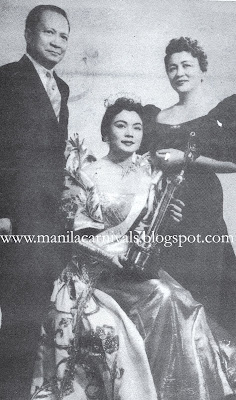
LIKE MOTHER, LIKE DAUGHTER. Daughter Edith Nakpil, like her mother, won the "Miss Philippines 1955" title at the Boys' Town Carnival. Edith is flanked by proud parents, Juan Nakpil and Anita Noble-Nakpil.

In 1973, Arch. Juan Nakpil was conferred the National Artist Award for his valuable contribution to Philippine architecture.Our first Miss Philippines, the accomplished and beautiful Anita Noble, passed away on 14 August 1979, after a bout with cancer.

Wednesday, December 17, 2008

42. 1923, MANILA CARNIVAL

MANILA CARNIVAL GROUNDS, 1923. Carnival parade at the Luneta, the annual venue of the biggest commercial and industrail exposition in the Philippines.

“Get the Carnival Spirit!”, was the rallying cry of the Carnival publicists for 1923, an encouragement that is hardly necessary in Manila. For with the approach of the opening day of the Carnival, by force of habit, the city changes its whole aspect and becomes a realm of fun, frolic and amusement.

This year’s Carnival pretty much kept the same ingredients that made the previous year’s edition successful.. For the 2nd year in a row, a Filipino was named as the Director General of the Carnival, Mr. Arsenio Luz who, to his credit, administered the 1922 Carnival with aplomb. He was described as a livewire and a “go-getter”, qualities needed to ensure that the big event runs smoothly, and that, more importantly, the Carnival makes both ends meet, financially.

RESIDENT PRESIDENT . Gov. Gen. Leonard Wood, again, the honorary president of the 1923 Philippine Carnival Association.

Notable officials of the Philippine Carnival Association included once more, Gov. Gen. Leonard Wood as honorary president. Senate Pres. Manuel L. Quezon headed the association, ably supported by a host of vice presidents and directors like Tomas Earnshaw, Dee C. Chuan, Sen. Antero Soriano, Felipe Buencamino Jr., and Gen. Thomas Hartigan. Permanent committees in charge of the event’s administrative aspects—like Fire Protection, Law and Order, Publicity, Chinese Participation and Sugar Industry Exhibit—were organized and staffed.

As the commercial-industrial fair was of utmost importance to businessmen, the concept of a Sample Fair, done in a special building, was retained. The nightly balls,the three parades and the military presentations were likewise kept, but the special attractions were beefed up. This year included a water circus, featuring, according to the Carnival publicity department, “some of New York’s most beautiful diving girls”. A children’s playground called Toyland, carried a profusion of toys and good things to eat. An Airplane Swing was also added so that one can enjoy all the sensations of an airplane flight safely and comfortably.

From Australia came boxing kangaroos. A “House of Ice” was the offering of San Miguel Company. Borromeo Lou returned with his vaudeville revues, and so didmany of the foreign magic acts. Films showing the Villa-Buff boxing championship and other fistic matches were screened nightly. To drive interest, a radio contest opened to amateurs was put up. The usual minor attractions were also there: popular booths that sold peanuts, popcorn, soda water, refreshments parlors and beer gardens.

Of course, highlighting the Carnival was the selection of a Carnival sovereign, a process that began three months before the actual Carnival week. The manner of selection was the same: publications ran contests to select candidates, one candidate per newspaper. Candidates were then voted for by the public, the ballots being attached to Carnival stock certificates. The trend was even keenly observed by beauty enthusiasts: for the first few carnivals, American girls were invariably chosen, but since the Filipinos have taken such an active part in the event, beautiful Filipinas have sat on the regal throne at the head of the big auditorium.

The hard work of all the officials and committees paid of, as the 1923 Carnival broke the previous year’s record in terms of stock sales and unprecedented attendance.

Sunday, December 14, 2008

40. 1922, MANILA CARNIVAL

The 1922 Manila Carnival and Industrial Fair was held from 4-12 February 1922, headed by the President of the Commonwealth, Manuel L. Quezon (L), with the Governor General of the Philippine Islands, Leonard Wood named as honorary president. Arsenio Luz (R) was the Director-General.

The premise of this year’s carnival was that “it is more than a fun and folly fiesta. The promotion of health, education, commerce, industry and community spirit are permanent interests of this great annual event”.

The Carnival authorities have spared neither effort nor expense in making the fair the biggest and best free attraction on the Carnival grounds. The Main Exhibition Building housed the displays of the Insular Bureaus, Provincial Governments and Business Houses of the Philippines. The National Federation of Women’s Clubs. American Guardian Association. Public Welfare Booth, Anti TB Society and the Red Cross had their booths in this building for demonstration purposes. Beneath the Tower of Jewels there is an attractive display of electrical merchandise.


ENTRANCE TO THE AUDITORIUM. Bluperint as drawn by Arch. Juan Arellano. 1922

Provincial representation was boosted by the booths of Iloilo, Leyte, Tayabas, Pampanga, Laguna, Rizal, Tarlac, La Union, Marinduque, Ilocos Sur, Cagayan, Cebu and Palawan, with each province showing off their best manufactured products.

THE CARNIVAL 1922 AUDITORIUM. A designed by Arch. Juan M. Arellano.

February 8 was designated as a “Merchants’ Day”, in recognition of the role of commerce in nation-building. The 3-day Far Eastern Commercial-Industrial Convention was held within the Carnival period, attended by members of the the chambers of commerce, ending with a fabulous “Merchant’s Ball”. A Sample Fair Theater was also set up for selling and order-taking of different commodities and products.

As always , the Army was well-represented in the Carnival by specially selected units of Infantry and Machine Gun, Mountain Artillery and Cavalry. February 7th was reserved for the Infantry Day, marked with squad drills, call to arms, salvo and volley firing and other military maneuvers like bareback and rough riding.

Special sideshow attractions included stunt performances by Oscar Varley Babcock, whose “Death Gap Loop”—in which his automobile goes on a swift descent down a narrow incline and makes a death-defying loop as it twists and turns—was billed as the most sensational feature of the 1922 Carnival. Borromeo Lou, the Filipino impresario, also wowed the evening crowds with the theatrical performances of his troupe. Other much-talked about acts included magicians and illusionists Orville the Great and Professor Shaw, with his mystifying card tricks and sleight of hands.

The 1922 Carnival staged a record number of 4 parades, starting on Feb. 4, with the Carnival Parade participated by costumed and uniformed groups. This was followed on subsequent days by a series of Educational Parades, Military Parades and the new Health Parades, to call attention to the widespread effort s of different health and civic groups to suppress disease and maintain a high standard of public health.


MAIN GATE OF THE 1922 MANILA CARNIVAL. As designed Arch. Juan M. Arellano.

For Carnival revelers, there were the opulent and festive balls to look forward to. Daily balls were held from 4 Feb. to Feb. 12., beginning with the International Ball, Parejas Ball (prizes to the Most Comic and Most Original Couple), Coronation Ball, Comparsa Ball, Children’s Fancy Dress Ball, Merchant’s Ball, Stockholders’ Ball, Army and Navy Ball, Popular Ball and finally, the Grand Carnival Ball.

COMMERCIAL AND INDUSTRIAL FAIR HALL. For exhibition of the country's finest manufactured produce.


An historical pageant was presented by the Dramatic Association of the University of the Philippines to picture the splendor of the court of the Rajahs of Manila before the coming of Legazpi. Characters like Lakandula and his Queen, Legazpi, Rajah Soliman, Augustinian priests, Spanish soldiers, dozens of native princesses and Asian merchants came to life in colorful costumes to thrill an adoring crowd.

Then there were the exciting Athletic Competitions that featured everything from Cricket. Soccer to Track, Golf, Bowling, Baseball, Volleyball and Basketball. A Dog and a Horse Show were even held to show off canines and equines of the most exotic kind.

The 1922 Manila Carnival will also be remembered for its Queen and her King Consort, she, a quiet, unassuming beauty and he, an American-educated achiever who, together, went on to win greater acclaim in the field of international diplomacy and government service.