Showing posts with label Carmen Fargas. Show all posts

Sunday, May 8, 2011

170. THE PETIT CARNIVALS OF ZAMBOANGA, part 2

ZAMBOANGUENA HERMOSA. Her Royal Highness Margarita Macrohon, queen of the 1934 Petit Carnival of Zamboanga.

The election of the Queen of the 1934 Petit Carnival of Zamboanga started in the second quarter of 1933, and by September 1933, the first canvassing of votes for the candidates was already undertaken. The five leading candidates were Remedios Caballero (510 votes), Marietta Hamoy (450 votes), Margarita Macrohon (310 votes), J. Torres (280 votes) and J. Marin (120 votes).

On October 28, the 9th counting showed a change in leadership with Margarita Macrohon on top with a whopping 8000 votes, followed by newcomer Susie Galle, Marietta Hamoy, Adela Johnston, Ella Varian and Remedios Caballero at the tail-end.

More concrete plans were also drawned up by the Carnival committee and exposed to the public by November. Local residents, however, raised eyebrows at the idea of a cabaret-style pavilion as one of the attractions of the petit carnival. Inter-school dance and costume contests were also planned, using the Manila program as the model.

The final tabulation to determine the 1934 Zamboanga Carnival Queen was done six days before Christmas. Margarita Macrohon was the runaway winner with 47, 470 votes. Her elected princesses were Remedios Caballero (2nd, with 23,810 votes) and Susie Galle (a close 3rd, with 21,810 votes).

Margarita Macrohon was already a popular young woman of Zamboanga society when she became queen. She had participated in the 1929 fiesta of the city’s patron Virgen del Pilar, crowning the “Princesa Floral” of the fiesta. She also joined the the Declamation Contest, a talent that ran in her family (brother Jun was a champion orator of Ateneo de Zamboanga).

In the Fancy Ball dance contests, Tetuan Elementary School placed first with their “Clown Dance” (under Maria Rodriguez), while the City School came in second with “Fairies Dance” (under Mary Hampton). In 3rd place was the contingent from Sta. Maria Elementary School with their “Russian Dance”.

When the fabulous Carnival of 1934 ended, the organizers realized a net profit of PhP 3.77 for their business venture—not exactly a great profit, but Zamboanga certainly had fun. And that was all that mattered.

169. THE PETIT CARNIVALS OF ZAMBOANGA, part 1

Ever since local mestiza girl Carmen Fargas put Zamboanga province in the national beauty map by winning “Miss Pearl of the Orient Seas” at the first ever Miss Philippines quest of 1926, the city was never the same again. Zamboangueños became determined to duplicate the festive mood of Manila by staging their own petit carnivals.


Zamboangueños were already celebrating Rizal Day, Garden Day and the city fiestas with spectacular results since the 1920s, and the petit carnivals were another welcome additions to their fondness for social revelry. Two petit carnivals—one in 1930 and the last in 1934-- stood out for the lavishness of the staging and the competitiveness of the candidates in the beauty search.

Antonio C. Orendain, author of “Zamboanga Hermosa”, had vivid recollections about these most-awaited events of the city:

“The Carnivals were exciting. The Red Rovers sponsored most of them… The (beauty) contest was the Carnival fund raiser in those days and sympathizers sold ballots for their candidates. Family prestige and personal popularity counted for victory more than beauty—physical, intellectual, moral. When the candidates were on an even keel in their attributes, the contest was feverishly exciting.

IN THE DAYS OF MILK & HONEY, Zamboanga residents celebrated their fiestas lavishly and indulged even more luxuriously in fairs and carnivals with beauty queen to boot. In the petit carnival of 1930, the beauteous Rosie Shinn reigned as the queen with the debonair Pab Sebastian as her consort. Completing her court was the lovely Luisa Fernandez and Josefina Fermin.
In one such contest did Conchita Albrecht of Maluso lose to Rosie Shinn of Zamboanga City. Both mestizas were ravishing beauties and the contest was talked about for years later. The coronation pageants were fanciful, ranging from Egyptian, Arabic or Moorish spectacles to metaphoric fantasies. From the time Carmen Fargas won the title of ‘Pearl of the Southern Seas’ in a national beauty contest in Manila, the metaphor was popularly adopted."


Carnival organizers engaged the services of the best decorators in the province. Ramon Ramirez, for instance, a town artist who embroidered garments for santos, decorated chapels for fiestas and taught folk dances for veladas, was commissioned to direct most of the pageantry of the petit carnivals. In Tetuan, Badong Azacarraga, had the final say in the artistic directions for the district festivities, while a certain Pinky did all the work in the Visayan center of San Jose.

In that romantic era, the winning queens were exalted and extolled, often depicted as pearls and, as such, had thrones designed like cockleshells. Symbolic representations were the fad and there was even a year when dancers danced out of a giant pot to pay tribute to the Carnival sovereign.

Tuesday, October 27, 2009

90. THE EXALTATION OF BEAUTY, II

That is not to say, however, that the Carnival participants were totally free from some form of exploitation, both subtle, overt and legitimate. After all, the Carnival was looked at as a business venture, and the beauty search was an accepted means of raise funds. Early publicity materials like to point out that every candidate representing “the piquancy of Morolandia, the grace of the Mountain Province, the charm of the Modern Filipina, not forgetting the dark-eyed Spanish mestizas, the blue-eyed daughters of American pioneers and the almond-eyed descents” can vie for, and win the queenship.


DAUGHTERS OF LUZVIMINDA. Beauties from Luzon (Miss La Union), Visayas (Miss Leyte) and Mindanao (Miss Lanao) converge at the 1927 edition of the Manila Carnival.

Those who were really in a better position to win the crown were daughters of de buena familia families who not only had the financial clout, but who also possessed sterling reputation and spotless character. Indeed, the voting public seemed to have placed a premium on the candidate’s distinguished background over physical beauty if one were to see the early list of winners. It was not necessary to make character investigations as the delegates were often handpicked by provincial officials and came to Manila with the most glowing recommendations.

REDEFINING THE STANDARDS OF BEAUTY. Carmen Papa, who, as one observer noted was "the least attractive, but certainly the gentlest", went on to win the 1925 Carnival Queen title. It also helped that his father, Ramon Papa, was a high profile member of the Philippine Commission.

Such was the case of the early winners like Pura Villanueva, whose feminist writings were already familiar to Manila society even if she wrote for regional newspapers. In 1925, queen-elect Carmen Papa, was described by beauty observers as being the least attractive among the candidates, but certainly “the gentlest”. The next year, when the choice for the Queen vacillated between Anita Noble of Batangas and Carmen Fargas of Zamboanga, the judges finally cast the deciding vote for the candidate with the more distinguished lineage—Anita Noble, who had the illustrious Agoncillos (diplomat Felipe, Maria, wife of Emilio Aguinaldo; Marcela, maker of the Philippine flag) on her bloodline.

Delegates of ethnic descent had slim chances of winning the crown given the stature of their provinces compared to imperial Manila which produced the most number of Carnival Queen winners (8), followed by Batangas with 3 (1913, 1923, 1926) and Iloilo, Bulacan and Pampanga with 2 winners. Even the backgrounds of the two Kapampangan winners were downplayed as Socorro Henson (1926) and Guia Balmori (1938) practically grew up in the city. The 1927 queen, Luisa Fernandez was actually from Tayabas, but represented Manila as she was a student in the city at the time of the contest.

PROMDI QUEEN. Provincial lasses held their own against the more sophiticated beauties from Manila and other key cities. Iloilo was the first province to have a daughter proclaimed as Carnival Queen, but only after the original Manila winner renounced her crown.


One would think that when a panel of judges replaced public subscription voting in 1926, the playing field for all contestants would be levelled. While it was true that Bala Amai Miring (Miss Lanao 1926) and Nora Maulana (Miss Sulu 1927) made it to the royal court as Misses Mindanao, the rules decreed at that time that the regional winners should authentically come from the provinces of Luzon, Visayas and Mindanao. This rule was revoked in 1930, and henceforth, the second, third and fourth placers were named as Miss Luzon, Miss Visayas and Miss Mindanao respectively.


MINDANAO MAIDENS. Nora Maulana and Bala Amai Miring (left and middle) were both named as Miss Mindanao in the 1926 and 1927 Carnival. Rules dictated then that the regional winners should come authentically from the region. No other Mindanao beauty won after the rules changed in 1930, where the regional titles were awarded to the 2nd, 3rd and 4th placers, irregardless of their origins . The third girl is Scott Rasul , Miss Sulu of 1926.

For ‘minority contestants’, the rule change practically reduced the chances of winning to virtually nil, paving the way for more Manileñas to place in the finals. There was quite a dissonance in the victory of Louise Stevens as Miss Mindanao 1931—as she was an American-mestiza and a Manila resident.

ALBAY CARNIVAL QUEEN OF 1935. Teresa Barrenechea. Provincial petit fairs were all the rage in the 1930s, with mini-carnivals staged everywhere from Cebu to Sorsogon, Capiz to Cagayan , Pampanga to Baguio.


The provinces thus, concentrated on their provincial fairs and expositions which, like the Cebu Carnivals, were said to rival the national event in Manila in terms of pomp and pageantry. Provinces like Baguio, Pangasinan, Bulacan, Tarlac, Sorsogon, Capiz and Pampanga held their own spectacular carnivals, electing Queens who did not have to go to Manila to compete for the Miss Philippines title; their royal duties were exclusive to their provinces alone.

Tuesday, January 27, 2009

50. 1926, Miss Pearl of the Orient Seas, CARMEN FARGAS

THE PEARL OF THE ORIENT SEAS. Carmen Caguiat Fargas, 1926 Miss Zamboanga. She gave the 1st Miss Philippines, Anita Noble, a stiff fight in the 1st National Beauty Contest of the Manila Carnival, that judges gave her a special title.

In 1926, the 1st National Beauty Contest was started, as a parallel pageant to the Manila Carnival Queen search. It was the first truly national quest for a queen as provincial representatives, each wearing the sash of their province, came to Manila to vie for the title of "Miss Philippines". It was also different in that, unlike Manila Carnival Queen which relied on public balloting, the selection was done by a panel of judges.


From Zamboanga came Carmen "Carmencita" Fargas, a mestiza beauty born on 16 January 1908 and bred in Aplaya, Ayala in Zamboanga. She was a student of Normal College when the contest beckoned, and was installed as an early favorite as the elected 1926 Miss Zamboanga. She found stiff competition from the 1926 Miss Batangas, Anita Noble, whose lineage included patriots and heroes from both sides of her family. But Carmen held her own, and as the judging reached its final stages, she found herself on top of the judges' list, a major contender for the crown.


In the first ballotting, the regional winners were easily determined, but it was a deadlocked tie for the Miss Philippines crown--between Carmen and Anita. A 2nd balloting did not resolve the issue, and it was only past midnight when Pres. Manuel L. Quezon stepped in and offered suggestions to the tired judges for a quicker resolution to the problem. As related in the previous entry, a final scrutiny of the contestants was done, this time with another judge added.


Thus, it was in this manner that the tie was broken--with Anita Noble pipping Carmen and emerging as Miss Philippines of the 1st National Beauty Contest. But so keen was the competition till the last minute that a special title --"Miss Pearl of the Orient Seas" (Perlas ng Silangan) was awarded to the equally deserving Carmen. At the proclamation of Miss Philippines, the Pearl of the Orient Seas also had her rightful place of honor. In the entire history of the annual Carnival, the 1926 edition was the only one that had 3 beautiful muses reigning together.


After the contest, Carmen went back to her schooling but her life was never to be the same again. Back in Zamboanga, she was caught in a whirl of activities-- attending provincial functions, crowning petit fair queens and participating in Rizal Day festivities. As Miss Zamboanga, she was succeeded by Manolita Villaescosa.
MISS PEARL OF THE ORIENT SEAS WITH MISS VISAYAS 1926, Carmen Fargas (1926 Miss Zamboanga) and Aurora Reyes (1926 Miss Samar)
Carmen managed to finish school and in her later life, she married Dr. Herminio Caguiat. Carmen was a whiz in the kitchen, both as a baker and cook. She was fond of Cadbury chocolates and enjoyed ice cream all her life. The beauty who almost became our 1st Miss Philippines passed away on 4 October 2004.


49. 1926, Miss Philippines of the Manila Carnival, ANITA AGONCILLO NOBLE

THE FIRST MISS PHILIPPINES. 20 year old Anita Agoncillo Noble of Lemery, Batangas, chosen at the 1st National Beauty Contest of 1926. Anita comes from a distinguished family of patriots and revolutionists.

The 1st National Beauty Contest search for the first Miss Philippines was launched with much fanfare and was met with resounding approval by provincial authorities. Quickly, municipalities conducted their own “Miss”, from among whom a provincial bet to the national contest was chosen. Batangas Governor Modesto Castillo however, already had a perfect candidate in mind, so he scrapped the local tilt and named his beauty of choice. No one criticized this arbitrary move, as his decision was met with unanimous approval. Anita Noble y Agoncillo of Lemery was named as “Miss Batangas” and was sent off immediately to the national contest.

MISS PHILIPPINES, 1st National Beauty Contest Winner. All official pictures of Anita as Miss Philippines show her crown-less. She reigned alongside the last Queen of the Manila Carnival, Socorro Henson of Pampanga.

Anita was the middle child and only daughter of Leoncio Noble and Maria Agoncillo, who, in turn come from distinguished families of Lemery. Leoncio managed the family estate in the Lemery-Taal area, while Maria was directly related to patriots Felipe Agoncillo, diplomat of the 1st Philippine Republic, Maria, 2nd wife of Emilio Aguinaldo, and Marcela, maker of the 1st Philippine flag.

Anita had two other siblings: Froilan and Vicente. When it was time for their higher education, the boys were sent to San Juan de Letran, while Anita was accepted as an interna at the nearby Santa Rosa College. It was indeed a surprise, that given her strict upbringing, her parents allowed her to participate in the contest. But inasmuch as she was always in the company of other girls and their chaperones, she was allowed to participate in the contest activities.

BELLE FROM BATANGAS. Another official photograph of Anita Noble as Miss Philippines. Curiously, she is the only queen of the Manila Carnival who never wore a crown in her photo sittings.

During the contest proper, she stayed in the home of Mr. and Mrs. Alfredo Roa Sr., together with Remedios Santos (Miss Rizal) and Amparo Neri (Miss Misamis). Mrs. Conchita Zamora Roa was their official chaperone. One of the most memorable event was a tea dance party given by the Bachelors’ Club to the candidates at the Hotel de Francia along Avenida Rizal. The candidates were paraded in the evening in decorated automobiles that wended its way around Rizal, Escolta, Taft Avenue and ending at the Manila Grand Carnival auditorium at the Luneta. Alighting from the cars, the candidates boarded individual wheeled chariots bearing the name of their respective provinces. Before an adoring crowd and a panel of judges, the candidates were thus presented and voted on.

The selection of the regional winners—Misses Luzon, Visayas and Mindanao—proved to be easy. But the choice for the plum Miss Philippines title ended in a tie between Miss Zamboanga (Carmen Fargas) and Miss Batangas (Anita Noble). Not even a second voting could break the tie. As it was already past midnight, Madame Levy, one of the judges, suggested the postponement of the deliberation for another day. It was then that President Manuel L. Quezon made his appearance. Apprised of the situation, the President invited the contestants the next day at the Manila Hotel. He stipulated that they be dressed in simple baro’t saya and wear no make-up, and that another judge be added to break the deadlock. The judging continued the next day—the girls were judged how they ate lunch!

NOBLE NOBILITY. Miss Philippines-elect Anita Noble, as she appeared in a large 1926 Carnival souvenir photo.


The stringent process finally yielded results with the breaking of the tie. Anita Noble, 20 year old Miss Batangas was chosen as the winner of the First National Beauty Contest. But so tight was the competition, that the Carnival officials decided to create another title for Zamboanga’s Carmen Fargas. She was named as “Miss Pearl of the Orient Seas”. Named as Miss Luzon was won by Rosario Genato (Manila), Miss Visayas was Aurora Reyes (Samar) and Miss Mindanao was Bala Amai Miring (Lanao).

"TALAGANG MAGANDA SIYA". A souvenir photo sent by a certain Polent to Ka Oriang has this dedication on the back: "Bagamat hindi ka nakapanood ng Carnaval ay heto si Miss Philippines at siya ang nanalo sa Beauty Contest, at takagang maganda siya". Dated 14 Feb. 1926.

Our first Miss Philippines was proclaimed with much hoopla in the jampacked Carnival Auditorium. Batangas Assemblyman Antonio de las Alas escorted Anita, the pride of Batangas, to the throne. Leopoldo Kahn stood by as her King Consort. With the dancing ending at 5 a.m., everyone agreed that 1926 was “the liveliest and most successful night in the history of the Carnival”.

Accolades continued to pour in for Anita. Her school presented a musical program in her honor and when she went home to Batangas, her proud province mates gave her a rapturous welcome. She was besieged by admirers but it was not until 9 January 1927 that she met Paris-educated Architect Juan Nakpil, son of revolutionist Don Julio Nakpil and Gregoria de Jesus, the young widow of Andres Bonifacio.

As a graduate student of Harvard where he continued his studies after France, Juan had previously heard of Anita via Carnival news clippings sent to him. Upon his return to the Philippines, Juan met Anita on the feast of the Black Nazarene, in the Quiapo house of his uncle, Dr. Ariston Bautista Lin.

ALL IN THE NAKPIL FAMILY. Anita and Juan had 3 boys in succession: Ariston, Francisco (who had just received their First Communion in this picture), Eulogio (standing in front). Annie sits at the right, and youngest Edith is on her mother's lap. taken in 1936.

Smitten, Juan pursued Anita, often traveling to Lemery every Sunday to woo and visit her. He finally won her on 10 December 1927, and they were wed in the evening highlighted by a reception held at the house of the Batangas Governor. The union bore 5 accomplished children: Ariston, Francisco, Eulogio, Annie (who became Miss Batangas) and Edith (who, too, became Miss Philippines 1955 of the Boys’ Town Carnival).

ANITA'S BOYS. With two of her boys, first-born Ariston and 2nd son Francisco. Still every inch a beauty, Anita was in her late 20s when this picture was taken.
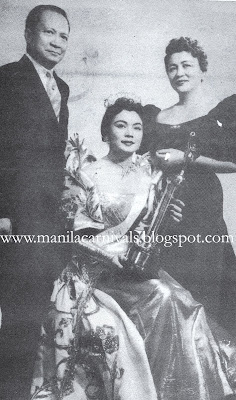
LIKE MOTHER, LIKE DAUGHTER. Daughter Edith Nakpil, like her mother, won the "Miss Philippines 1955" title at the Boys' Town Carnival. Edith is flanked by proud parents, Juan Nakpil and Anita Noble-Nakpil.

In 1973, Arch. Juan Nakpil was conferred the National Artist Award for his valuable contribution to Philippine architecture.Our first Miss Philippines, the accomplished and beautiful Anita Noble, passed away on 14 August 1979, after a bout with cancer.